
A Complete Guide to Family Constellation Therapy
Barry Krost
Estimated Reading Time: 25–30 minutes
Originally Published: July 2026
Last Updated: October 2026
Whether you're new to Family Constellations or already familiar with the approach, this guide is designed to help you build your understanding step by step. Read from beginning to end for a comprehensive introduction, or use the table of contents to explore the sections most relevant to your interests.
Table of Contents
Introduction
Part One: Understanding Family Constellations
Understanding the Family System
How Does a Family Constellation Explore a Challenge?
What Happens During a Family Constellation?
See How a Family Constellation Is Organized
What Are the Different Ways to Experience Family Constellations?
What Are Representatives in Family Constellations?
Part Two: Principles and Practice of Family Constellations
The Phenomenological Approach and the Knowing Field
The Principles That Guide Family Constellations
Belonging: Everyone Has a Place
Order: Why Sequence Matters in Families
Balance: Giving and Receiving in Relationships
Why Do Family Patterns Repeat Across Generations?
How Can Family Patterns Change?
Why Do the Words Used in a Constellation Matter?
Part Three: Continuing Your Exploration
What Can Family Constellations Help Us Explore?
Systemic Value and Scientific Evidence
Family Constellations as an Ongoing Way of Seeing
Continue Your Exploration
Frequently Asked Questions
About Barry Krost
A Personal Invitation
Introduction
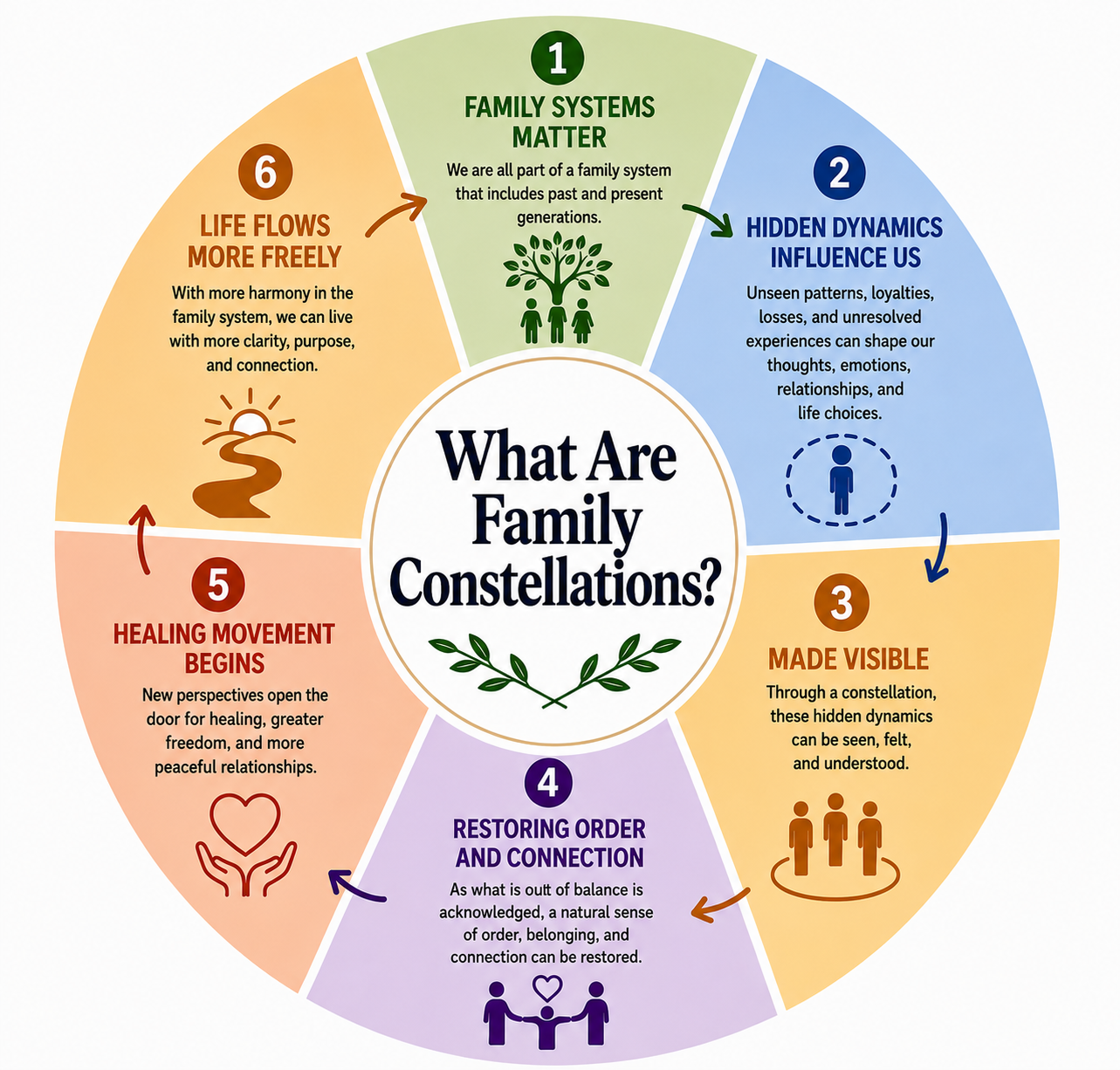
Every family carries a history. Alongside the stories that are remembered and shared are experiences that may remain largely unseen yet continue to influence later generations. Family Constellations explores how these experiences may shape present-day relationships and repeating family patterns.
Family Constellations is an experiential approach that explores people's lives within the context of their family system. It considers how family relationships, significant life events, and experiences across generations may contribute to the challenges a person faces today. Challenges that seem purely personal may also be connected to the experiences of those who came before.
Family Constellations was developed by Bert Hellinger and has since evolved through the work of practitioners around the world. It is practiced internationally in group and individual settings, both in person and online.
During a Family Constellation, a person brings a question, concern, or life challenge. Family members and other significant elements are represented so that relationships, patterns, and movements within the family can be brought into view. The facilitator and participants attend to what emerges without beginning with a predetermined explanation.
People often discover this work when relationship difficulties, family conflict, anxiety, grief, or a persistent sense of not belonging remain difficult to understand through their own life experiences alone. They may wonder whether unconscious loyalty, exclusion, or unresolved experiences in earlier generations are connected to what they are facing.
This guide introduces the family system, explains what happens during a constellation, and develops the principles of belonging, order, and balance. It then considers unconscious loyalty, entanglement, healing sentences, and the distinction between systemic value and scientific evidence. Supporting Resource Library articles offer further exploration of individual subjects.
My approach to this guide draws on my study of Family Constellations since 2003, my experience facilitating and teaching the work, and more than four decades of professional practice in bodywork, somatic education, and systemic healing. Family Constellations teachings and facilitator observations are distinguished from scientific evidence.
The purpose is to help you understand the approach and consider its relevance to your own questions, relationships, or professional interests.
Part One: Understanding Family Constellations
1. Understanding the Family System
When most people think about family, they think about the people they know—their parents, children, siblings, grandparents, and relatives.
The family system also includes earlier generations and people whose place in the family may have been forgotten, concealed, or excluded. Not knowing someone or speaking about them does not remove them from the family’s history.
Family Constellations looks at this system as a network of relationships unfolding over time. Births, deaths, separations, former partnerships, migration, war, and other significant events become part of that history. The experiences of one family member can affect others, including those born later.
This does not mean that family history explains every difficulty. It means that understanding a person’s experience sometimes requires looking beyond the events of their own life.
Questions that help bring this history into view include:
How have important events shaped the family?
Which family experiences continue to echo across generations?
What patterns seem to repeat over time?
How do experiences of belonging, exclusion, loss, or loyalty affect the family as a whole?
These questions guide exploration without deciding in advance what will be found.
2. How Does a Family Constellation Explore a Challenge?
A Family Constellation begins with the concern a person brings. This might be a repeating relationship difficulty, conflict with a parent, unresolved grief, or a sense of carrying something they cannot explain.
The concern gives the exploration its focus. The facilitator asks about relevant family relationships and significant events, attending to facts such as an early death, a separation, or someone who has been excluded. These facts help determine which people or elements to represent in the constellation.
Representing them brings the issue into a form that can be experienced and observed. Where representatives stand, whom they turn toward, and what they report may reveal connections that were difficult to recognize through conversation alone. In an individual session, objects, markers, or visualization provide other ways to explore these relationships.
The process does not begin by deciding that a particular family event caused the person’s difficulty. It allows the concern to be explored in relation to the family, with attention to what becomes visible as the constellation unfolds.
A different perspective does not always change the circumstances we face. It can, however, change how we understand and experience them.
3. What Happens During a Family Constellation?
No two Family Constellations are exactly alike. Although each unfolds differently, the process usually begins in the same way—with careful listening.
After discussing the concern and relevant family facts, the facilitator helps the person set up the constellation. In a group, participants are chosen to represent family members or other significant elements and are placed in relation to one another. In an individual session, objects or floor markers may be arranged, or the relationships may be explored through visualization.
The initial arrangement provides a starting point. Representatives notice and describe their experience, including physical sensations, feelings, where their attention goes, or an impulse to move. The person receiving the constellation observes what unfolds and may later enter the constellation themselves.
The facilitator attends to these experiences while feeling the systemic dynamics and drawing on insight and intuition. As the constellation develops, they may ask a question, include another representative, explore a movement, or offer words that acknowledge a relationship or significant event. Each step responds to what is emerging.
A constellation may bring an excluded person into view, reveal a burden carried for someone else, or clarify the places of parents and children. These possibilities are explored without requiring the constellation to reach a particular resolution.
The session ends when the facilitator recognizes an appropriate stopping point. Not everything needs to be explained or resolved. What has become visible is given time to settle, and its significance may continue to unfold afterward.
See How a Family Constellation Is Organized
The following video is not a recording of an actual Family Constellation session. Instead, it uses simple objects to demonstrate the basic structure of a Family Constellation.
It shows how family members are represented and how their positions allow relationships to be explored. As you watch, notice how the facilitator proceeds one step at a time, responding to what becomes visible rather than deciding the outcome in advance.
4. What Are the Different Ways to Experience Family Constellations?
Family Constellations is not a single technique. It is an experiential approach that can be explored in different ways. Group and individual work share the same systemic foundation and can take place in person or online.
Group Family Constellations
Group Family Constellations bring people together to explore personal, family, or relationship concerns in a shared setting. Participants may receive a constellation, volunteer as representatives, or witness the work. Representatives stand for family members or other significant elements, while witnesses observe the constellation as it unfolds. Participation in each role offers a different way to experience and learn from the work.
Private Family Constellations
Family Constellations can also be explored in one-to-one sessions. Facilitators may use objects, floor markers, visualization, drawings, or other approaches to represent family members and relationships. The person explores their concern privately with the facilitator. Some individual sessions also include other people serving as representatives.
Online Family Constellations
Online sessions bring participants together by video. Groups can work with representatives joining from different locations, while individual sessions may use objects, markers, visualization, or representatives. The practical arrangements are adapted to the online setting while retaining the principles of the work. Topic workshops provide another way to explore particular family dynamics in a group.
Couples and Relationship Constellations
Family Constellations may also be used with couples or individuals exploring relationship concerns. The work considers the relationship between the partners and the family history each brings to it. Earlier losses, former partnerships, and loyalties to parents or previous generations may become relevant to understanding what happens between them.
The choice of format depends on a person's goals, preferences, circumstances, and the nature of the question they wish to explore.
5. What Are Representatives in Family Constellations?
Representatives are participants who stand for family members or other significant elements within a constellation. They do not need to know the people they represent or have detailed information about the family.
Rather than asking representatives to act, perform, or imagine what another person is thinking or feeling, Family Constellations invites them simply to observe and share their experience as the constellation unfolds.
Representatives may notice changes in where they feel drawn to stand, how they experience the space around them, physical sensations, emotions, or impulses to move. Sometimes they notice very little. They report what they experience without trying to create a response or explain what it means.
For example, a representative may feel drawn toward one person and unable to turn toward another. The facilitator attends to this movement in relation to the constellation as a whole, without immediately assigning an explanation.
A representative’s experience is part of the exploration. It does not, by itself, establish what another person thinks or feels, or prove that an event occurred in the family’s history.
Through their positions, responses, and movements, representatives help bring family relationships and systemic dynamics into view. The next section introduces the phenomenological approach and the Knowing Field through which this experience is understood in Family Constellations.
Part Two: Principles and Practice of Family Constellations
1. The Phenomenological Approach and the Knowing Field
Family Constellations works through a phenomenological approach: attending to what is experienced before deciding what it means. Rather than beginning with a fixed theory or predetermined interpretation, the facilitator remains receptive to what becomes visible through the constellation. Observation includes listening, feeling systemic dynamics, and allowing insight and intuition to inform the next step.
The Knowing Field names the field of experience through which representatives and participants become aware of relationships and dynamics within the family system. A representative who knows little about the family may experience feelings, sensations, or movements that appear meaningful in relation to the person or element they represent.
Within Family Constellations, these experiences are attended to as part of the constellation. They can bring previously unspoken or unrecognized relationships, losses, exclusions, and loyalties into view. Naming this experience the Knowing Field does not explain how it occurs or establish a scientific mechanism.
Working within the Knowing Field does not require the person receiving the constellation to explain or fully understand every experience immediately. What emerges is allowed to develop without being forced into a final interpretation.
2. The Principles That Guide Family Constellations
Bert Hellinger articulated guiding principles through his observations of family relationships during constellations. Commonly known as the Orders of Love, they include belonging, order, and balance in giving and receiving. Facilitators continue to explore these principles through their practice.
Belonging concerns each person’s place in the family system. Order concerns the sequence of generations and relationships. Balance concerns the exchanges that sustain relationships and the different movements of giving and receiving between parents and children and between adult partners.
These principles provide a framework for recognizing where someone has been excluded, where family places have become confused, or where an exchange has become unequal. They describe systemic relationships rather than prescribe how every family should live.
The principles guide the facilitator’s attention without determining what a particular constellation must reveal. The sections that follow explain each principle and its significance within family relationships.
3. Belonging: Everyone Has a Place
Everyone belongs. Within the family system, a person’s place does not disappear because they have died, been forgotten, or been excluded.
This includes children who died before or shortly after birth, relatives whose lives were concealed, and family members rejected because of their actions or circumstances. Former partners also have a place in the history of the relationships that followed.
Exclusion does not end a person’s connection to the family. In Family Constellations, a later family member may become entangled with someone whose place has not been acknowledged, carrying a burden or repeating a pattern connected to them.
Belonging does not mean that every action is sanctioned or that every relationship in the network is healthy. Recognizing a person’s place does not make harm acceptable or remove responsibility for what they did.
Acknowledging someone's place in the family does not require forgiveness, reconciliation, or continued contact. It recognizes that they belong, while allowing their actions and fate to remain their own.
4. Order: Why Sequence Matters in Families
Every family unfolds over time. Parents come before children. Older generations come before younger generations. Earlier relationships become part of the history that later relationships inherit.
Order recognizes this sequence and each person’s place within it. It does not measure a person’s worth or give one family member authority over another.
Children remain their parents’ children even after becoming adults. When a child takes responsibility for a parent as though they were the parent’s parent, these places become confused. The child may carry responsibilities that belong to the older generation. Recognizing order allows care for a parent without taking over the parent’s place or fate.
Earlier partnerships also remain part of the family’s history. A former partner with whom someone shares children retains their place as those children’s parent. Acknowledging that place does not require renewing the partnership; it recognizes the relationship through which the children came.
Within a constellation, attention to order helps reveal where someone is standing in another person’s place or carrying responsibility that belongs elsewhere. Recognizing who came before and what belongs to each person brings these relationships into clearer view.
5. Balance: Giving and Receiving in Relationships
Every relationship involves giving and receiving. The movement differs between parents and children and between adult partners.
Life comes to children through their parents. Care, protection, and support are also the parents’ responsibility, although what children actually receive varies. Children cannot repay the gift of life in equal measure, nor are they expected to do so. They carry life forward through their own lives, whether by caring for another generation or contributing in other ways.
Between adult partners, friends, colleagues, and many other relationships, the movement is different. Both people give and receive. A gift, an act of care, or practical support invites a response, allowing the exchange to continue. Although the exchange is rarely equal in every moment, both people have opportunities to give, receive, appreciate, and respond to one another.
When one person continually gives and the other continually receives, the exchange becomes unequal. The person who gives may feel unacknowledged or resentful; the person who receives may feel indebted or unable to respond. These experiences draw attention to what is happening between them.
Balance does not require keeping score or exchanging identical things. It concerns whether both people have a place as givers and receivers, with attention to their circumstances and capacities. In a constellation, this principle helps clarify an unequal exchange or an attempt to repay a parent by carrying responsibilities or burdens that belong to them.
6. Why Do Family Patterns Repeat Across Generations?
A relationship pattern, an emotional burden, a family conflict, or a significant life event may appear in different forms across multiple generations. Sometimes these repetitions are easy to recognize. At other times, they become visible only when the family's history is brought into view.
Family Constellations understands unconscious loyalty as a connection to family members through love and belonging that influences a person without their awareness. A descendant may remain loyal to someone who suffered, was excluded, or could not fully turn toward life.
Entanglement occurs when a person becomes identified with another family member’s experiences or fate, carrying something as though it were their own. For example, someone may find it difficult to allow themselves success while remaining loyal to a parent or grandparent who lost everything. The person may experience moving forward as leaving that family member behind.
Interrupted connection with a parent is another important dynamic. When a child’s movement toward the parent cannot be completed, carrying the parent’s suffering or becoming involved in earlier family burdens may become a way of remaining connected. This is one way unconscious loyalty can develop; it is not the explanation for every entanglement.
Blind love describes the love that seeks connection without seeing the consequences of carrying another person’s burden or repeating their fate. The love is real, but taking on the suffering does not resolve what happened to the other person.
Recognizing these unconscious loyalties may open the possibility of responding differently while continuing to honor one's connection to the family.
7. How Can Family Patterns Change?
In Family Constellations, movement begins with recognizing what has been carried and the person or event to which it belongs. An excluded family member is given a place. A loss is acknowledged. Responsibility is recognized where it belongs, and the distinction between one person’s fate and another’s becomes clearer.
For someone who has remained loyal to a grandparent’s financial loss, the movement is to see the grandparent and what happened to them. The loss belongs within the grandparent’s life and circumstances. The descendant can acknowledge that fate without making continued hardship the expression of their love.
This does not remove the connection to the family. It changes the way that connection is lived. Love does not require repeating another person’s suffering, and belonging does not require carrying their burden.
The past remains in the past. Healing can reach those who came before, while also changing the descendant’s relationship to them and what they have carried. This movement is experienced within the constellation rather than imposed as an instruction to let go or move on.
What follows differs from person to person. Recognition may be immediate, while its significance develops gradually as the person returns to everyday life.
8. Why Do the Words Used in a Constellation Matter?
Healing sentences give voice to relationships, facts, and movements that become visible during a constellation. They may acknowledge someone’s belonging, recognize a loss, distinguish responsibility, or express the relationship between a parent and child.
Simple words such as “You belong” or “You are my father, and I am your child” can name what needs to be recognized. Their significance comes from the relationship and the moment in which they are spoken, rather than from the words alone.
They are not affirmations or positive thinking, nor are they intended to erase painful experiences or produce a particular emotional response. The facilitator offers words in response to what is unfolding, allowing the participant to notice whether they fit. A participant does not have to repeat a sentence or accept an interpretation that does not correspond to their experience.
Because every constellation is unique, there are no universal healing sentences that apply to every person or every situation. Their meaning depends on the people, relationships, and family history present within each constellation.
Sometimes a few words support a movement that has already begun. At other times, silence allows what has become visible to be experienced without further explanation.
Part Three: Continuing Your Exploration
What Can Family Constellations Help Us Explore?
People bring questions about relationships, their place in the family, significant losses, and patterns that continue across generations. Examples include:
Relationships
Why do similar relationship patterns keep repeating?
Why am I drawn to emotionally unavailable partners?
Why do I struggle with intimacy or trust?
Why do certain family relationships remain difficult?
Family History
How might family history continue to influence my life?
Am I carrying a burden connected to an earlier generation?
Who has been forgotten, concealed, or excluded?
How have war, migration, violence, or significant losses affected the family?
Belonging and My Place in the Family
Why do I feel anxious, ashamed, invisible, or like I do not belong?
Why do I feel responsible for a parent’s happiness or suffering?
Why does living my own life feel disloyal to my family?
Life Transitions
How do major life changes affect family relationships?
How can I care for aging parents while remaining in my place as their child?
How do families respond to illness, loss, or significant change?
These questions provide a starting point. The constellation explores the particular relationships and events involved, rather than assuming that similar concerns have the same systemic explanation.
Systemic Value and Scientific Evidence
The systemic value of a constellation concerns what it brings into view: a family relationship, an exclusion, an unconscious loyalty, an entanglement, or responsibility carried for someone else. A participant may recognize a longstanding issue differently, even when their circumstances do not immediately change.
Participants report different experiences. Some describe feeling less burdened or finding a different sense of their place in the family. Others experience limited or no change. These reports and the facilitator’s observations are distinct from scientific evidence.
Scientific research on Family Constellation Therapy remains limited. It does not currently have an evidence base comparable to established psychological treatments. Further high-quality research is needed to assess its effectiveness and the conditions under which it may be helpful.
The teachings presented in this guide—including entanglement, the Knowing Field, and healing reaching earlier generations—belong to the Family Constellations framework. They should not be presented as scientifically established mechanisms or proof of clinical effectiveness. Family Constellations does not replace psychotherapy, psychiatric care, medical treatment, or crisis support.
Family Constellations as an Ongoing Way of Seeing
Understanding the principles is a beginning. Experiencing a constellation brings those principles into contact with particular people, relationships, and events. What becomes visible may challenge a familiar family story or reveal a connection that had not been recognized.
Acknowledging what happened includes recognizing responsibility where it belongs. It also allows each person to be seen within their own life and circumstances, without requiring a descendant to carry their burden or repeat their fate.
The significance of a constellation may continue to unfold afterward. There is room to let the experience settle before turning it into an explanation or deciding what to do.
Family Constellations does not ask us to reach a final conclusion about our family. It invites us to continue observing, learning, and discovering what may become visible through our relationships, our family history, and our own lived experience.
Continue Your Exploration
The following Resource Library articles develop the main subjects introduced in this guide. Begin with the area you want to understand more fully.
Principles and Practice
Family Relationships and Repeating Patterns
Evidence and Integration
History and Further Study
For articles on particular concerns—including grief, parentification, estrangement, intimacy, and belonging—explore the complete Resource Library.
Family Constellations Resource Library
Frequently Asked Questions
As people begin learning about Family Constellations, many of the same questions naturally arise. The following answers address some of the common questions people ask when first exploring this work.
-
Family Constellations is an experiential approach that explores a person’s concerns within their family relationships and history. Through representatives, objects, markers, or visualization, it brings relationships and systemic dynamics into view, including belonging, exclusion, unconscious loyalty, and entanglement.
-
Family Constellations is a systemic and experiential approach. Some qualified psychotherapists incorporate it into their practice, but a Family Constellation session is not automatically psychotherapy. The service depends on the practitioner’s qualifications and professional role. Family Constellations does not replace psychotherapy, psychiatric care, medical treatment, or crisis support.
-
You do not need a complete family history. Known facts about significant relationships, deaths, separations, exclusions, or other major events can help orient the exploration. Unknown information can remain unknown; a constellation does not establish historical facts or require you to fill gaps with assumptions.
-
No particular belief is required. You can attend to what you experience without accepting an explanation of how it occurs. The Knowing Field is a term used within Family Constellations for the field of experience through which relationships and dynamics become perceptible during the work.
-
People bring concerns about repeating relationship patterns, conflict with parents or siblings, grief, estrangement, belonging, guilt, and burdens that seem difficult to understand through their own life history. The constellation explores the particular family relationships and events relevant to the concern.
-
Yes. Online groups work with representatives joining by video. Private sessions may use objects, floor markers, visualization, or other people serving as representatives. The practical arrangements are adapted to the setting while retaining the systemic foundation.
-
No. Representatives are one way of experiencing Family Constellations, but they are not the only way. Private sessions often use simple objects, markers, or visualization to explore relationships within the family system while working with the same underlying systemic principles.
-
The facilitator asks about your concern and relevant family facts, rather than requiring a detailed account of everything that happened. You can discuss what you are comfortable sharing. In a group, what you say is heard by other participants, so discuss privacy expectations with the facilitator beforehand.
-
There is no standard number. Some people explore a particular concern in one session. Others return when another issue emerges or when they wish to continue the exploration. Further sessions are considered in relation to the person’s circumstances and what became visible.
-
Scientific research remains limited, and Family Constellation Therapy does not currently have an evidence base comparable to established psychological treatments. Participant reports and facilitator observations should be distinguished from scientific proof. Its systemic value concerns what the work brings into view rather than a guaranteed clinical outcome.
-
No single approach suits everyone. Your interests, circumstances, expectations, and the facilitator’s approach all matter. A preliminary conversation can help you understand how the work is conducted and decide whether you wish to participate. You do not have to accept a particular interpretation or continue with work that does not fit your experience.
About Barry Krost
Barry Krost has worked professionally in bodywork since 1983 and has been studying Family Constellations since 2003. His work draws on more than four decades of practice in bodywork, somatic education, and systemic healing, together with his experience facilitating constellations for individuals, couples, and groups.
He teaches Family Constellations internationally through workshops, group programs, and his Training & Certification Program. He has presented at international systemic constellations conferences and mentors facilitators in their developing practice.
His phenomenological approach emphasizes careful observation, feeling systemic dynamics, insight, and intuition. The Resource Library extends this teaching through clear explanations of family relationships, significant events, and the principles that guide Family Constellations.
A Personal Invitation
If these pages have encouraged you to think differently about yourself, your relationships, or your family history, you may wish to continue the exploration in a more personal way.
Private Family Constellations offers a confidential setting to explore your own concern with me. We begin with your question and attend to the family relationships and significant events connected to it. You can also participate in a group as a client, representative, or witness.
If you are considering this work, a complimentary consultation provides an opportunity to ask questions and discuss which format may suit your circumstances.
Explore Private Family Constellations
Schedule a Complimentary Consultation
The Family Constellations Resource Library is provided for educational purposes. It does not provide medical, mental health, legal, or crisis advice and is not a substitute for care from an appropriately qualified professional.
