
Family patterns can continue through the ways children learned to preserve connection and through unconscious loyalty to earlier family suffering. The circumstances may change while a familiar sacrifice, loss, or limitation returns. Family Constellations considers whom or what the repetition connects a person to, and why a pattern may persist even when the person consciously wants a different life.
Introduction
Many people notice repeating patterns within their family that seem to recur across generations. These patterns may involve relationship difficulties, ongoing conflict, addiction, emotional suffering, abandonment, illness, financial struggles, caregiving roles, or experiences of trauma and loss. Over time, these recurring themes can shape the way individuals relate to themselves, others, and the world around them.
Often, similar emotional themes emerge across multiple generations, even when family members genuinely hope for different outcomes.
A person may find themselves repeating experiences they promised they would never repeat.
Someone raised around conflict may continue experiencing conflict in relationships.
A child who learned to care for everyone else may become the adult who carries responsibility for others.
Family Constellations offers one way of understanding why family patterns continue across generations. Rather than viewing these experiences simply as individual choices, it explores how belonging, early relationships, unresolved trauma, unconscious loyalty, and family relationships may continue influencing later generations in ways that are often difficult to recognize.
Families Carry More Than Genetics
Families pass on far more than physical characteristics. Children also absorb emotional patterns, relationship dynamics, and nervous system responses. They learn beliefs about safety, belonging, and relationships while often taking on emotional coping strategies and family roles that develop naturally within the family environment.
Much of this transmission happens through everyday relationships and the emotional atmosphere within the family. Long before children understand what is happening around them, they are already learning how relationships work, what feels safe, and what it means to belong. Over time, these experiences become the foundation for many later relationships, emotional responses, and ways of relating to the world.
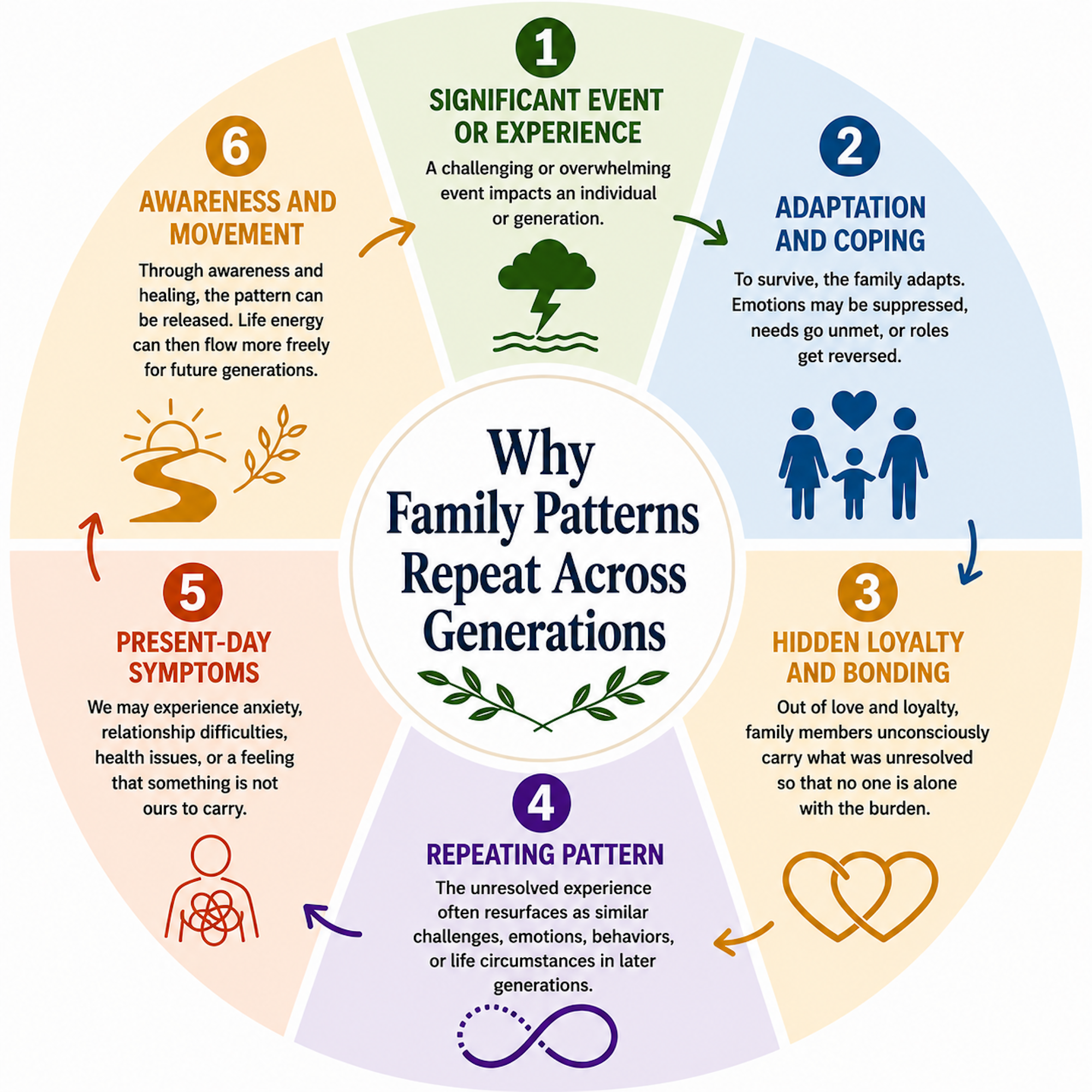
The key ideas presented so far come together in the visual map below, showing how hidden family patterns may develop and how greater awareness can support movement toward healing.
The Need to Belong
One of the central observations in Family Constellations is that every child has a deep need to belong. Belonging is closely connected to survival, emotional safety, identity, and connection with the family.
Because belonging feels so essential, children naturally adapt to whatever is emotionally present within their family. Some adaptations support resilience and healthy development. Others arise in response to conflict, trauma, emotional distance, loss, or instability.
Children rarely make these adaptations consciously. They simply do what helps preserve connection. Sometimes those adaptations continue long after the original circumstances have changed.
Why Family Patterns Repeat
Family patterns rarely repeat because people consciously choose them. More often, they continue because the ways children learned to preserve connection in their earliest relationships remain active in adult life.
Children who grow up believing that love requires self-sacrifice may continue sacrificing themselves in adult relationships. Someone raised around emotional distance may later feel drawn toward emotionally unavailable partners. A child who became responsible for everyone's well-being may naturally continue taking care of others throughout adult life.
Relationships often provide some of the clearest examples of how these patterns repeat. Emotional distance, rejection, conflict, caretaking, abandonment, or difficulty trusting others may continue across relationships until the underlying dynamics become more visible.
Patterns may continue both through what children learn and experience directly within their families and through unconscious loyalties to unresolved experiences from earlier generations.
How Repeating Family Patterns May Appear
Repeating family patterns can take many forms. They may become visible through experiences such as:
repeatedly entering similar relationship dynamics
feeling responsible for other people's happiness or well-being
struggling to receive love, support, or care
repeating patterns of conflict, abandonment, or emotional distance
feeling guilty about having more success, happiness, or freedom than other family members
taking on familiar family roles even when they are no longer necessary
The pattern itself may look different from one generation to another while the underlying emotional or relational dynamic remains similar.
When Success Becomes Connected to an Earlier Loss
For example, a grandfather lost his business and never regained his former place in the community. His daughter works hard but turns down opportunities that would bring greater recognition. Her son builds a successful business, then repeatedly withdraws just as it begins to prosper.
The circumstances are different, but a constellation can bring their connection to the grandfather’s loss into view. Through unconscious loyalty, the daughter and grandson may feel that having more success or recognition would leave him behind. Their lives become limited by what he lost.
Acknowledging the grandfather’s loss allows them to recognize whose experience their success has become connected to. They can respect what happened to him and remain connected through love while allowing their own lives to develop beyond that loss.
Unconscious Loyalty
Unconscious loyalty can connect a repeating pattern to someone One way Family Constellations understands repeating patterns is through unconscious loyalty. Children naturally love their families long before they understand them. That love sometimes becomes loyalty.
A person may unconsciously feel:
"I will suffer like you."
"I will carry this for you."
"I will not have more than you."
"I will stay connected through pain."
What appears self-defeating from the outside may represent an unconscious attempt to preserve belonging within the family system. From this perspective, repeating patterns are often expressions of love and loyalty rather than deliberate choices.
Unconscious loyalty can connect a repeating pattern to someone whose suffering, loss, or fate remains unresolved within the family. A descendant may repeat part of that experience as a way of remaining close to the earlier person, even without knowing the family history. The repetition does not need to reproduce the original event exactly. It may instead appear through recurring sacrifice, separation, loss, or limitations that reflect an earlier family member's experience.
Recognizing the earlier person and the connection maintained through loyalty can bring a different understanding of the repeating pattern. It also helps distinguish patterns connected to earlier generations from those arising through a person's direct childhood experiences.
When the Past Continues Into the Present
Unresolved experiences within a family may also continue influencing later generations. Trauma, grief, exclusion, family secrets, addiction, violence, abandonment, or early loss may leave emotional and relational effects that continue long after the original events have passed.
When important experiences remain hidden, unacknowledged, or emotionally unfinished, later generations may find themselves carrying emotional burdens they cannot fully explain. This does not mean people are destined to repeat the past. Rather, it invites us to consider whether recurring patterns may sometimes be connected to family experiences that have not yet been seen or acknowledged.
Movement Toward Healing with Family Constellations
Movement toward healing begins when a repeating pattern is seen within the family system rather than understood only as an individual failure or deliberate choice. A constellation can make visible the person, event, loss, exclusion, or fate to which the pattern is connected and the unconscious loyalty through which it preserves belonging.
When excluded family members are given their place, unresolved events are acknowledged, and responsibilities and burdens remain with those to whom they belong, later family members can honor the past without repeating it. The pattern no longer has to remain the primary way of maintaining connection, and a different movement becomes possible.
Repeating patterns develop through many influences. Family Constellations offers a systemic perspective on their possible connection to family history but does not assume that every recurring pattern originates within the family system.
About the Author
Barry Krost has been studying Family Constellations since 2003 and has over 40 years of experience in bodywork, somatic education, and systemic healing. He teaches Family Constellations internationally, mentors facilitators through his Training & Certification Program, and has presented at international systemic constellations conferences.
His Resource Library draws on decades of professional experience and ongoing study, offering clear, thoughtful, and grounded education for individuals and professionals seeking to better understand Family Constellations.
Explore Further
You may also be interested in:
What Is Inherited Family Trauma?; ; The System Remembers the Excluded;
Ready to explore how these dynamics may be affecting your own life?
Learn about Private Family Constellation Sessions Online or join an Online Group Session.
Frequently Asked Questions
Why do family patterns repeat across generations?
Patterns may repeat through belonging needs, nervous system conditioning, family roles, unconscious loyalty, unresolved trauma, and emotional learning within the family.
What are unconscious family loyalties?
These are hidden emotional bonds that may lead people to repeat suffering, roles, or relationship patterns from earlier generations.
Can trauma affect later generations?
Yes. Unresolved trauma may continue influencing emotional and relational patterns within families across time.
Why do people repeat unhealthy relationships?
People may recreate familiar relationship patterns because they feel known, even when they are painful or no longer serve them.
Are repeating patterns always caused by trauma?
No. Repeating patterns may also arise from family roles, interruptions in connection, belonging needs, learned relationship dynamics, and unconscious loyalty within the family system.
Can Family Constellations help reveal repeating patterns?
Family Constellations provides one way of exploring unconscious family dynamics, loyalties, exclusions, interruptions, and generational influences that may contribute to repeating patterns.
Can relationship patterns repeat across generations?
Yes. Family Constellations explores how experiences involving intimacy, abandonment, emotional availability, conflict, caregiving, or trust may repeat across generations. These patterns often operate outside conscious awareness until they become more visible.
Why do I keep repeating the same mistakes?
Many repeating patterns are not simply personal choices or failures. They may reflect unconscious loyalty, learned ways of relating, unresolved trauma, interrupted connection, or emotional strategies that once helped preserve connection and belonging within the family.
Can family secrets contribute to repeating patterns?
Family Constellations suggests that hidden trauma, exclusion, family secrets, and unresolved experiences may continue influencing emotional and relational patterns across generations. What remains unacknowledged may continue influencing the family in ways that are difficult to recognize.
Can repeating family patterns change?
Yes. Awareness is often the first step. As people recognize unconscious loyalties, inherited dynamics, and familiar emotional patterns, they may develop greater freedom to make different choices and create new experiences in relationships and life.
