
Love can lead a child to carry a parent’s suffering or a person to repeat an earlier family member’s fate. The intention is connection, but the movement can disturb each person’s place. Family Constellations considers how belonging, order, and giving and receiving shape the expression of love, particularly when loyalty becomes entanglement or misplaced responsibility.
Introduction
In Family Constellations, love alone is often not enough.
From a systemic perspective, love flows most freely when it is supported by order. Without it, love may become burdened by unconscious loyalty, misplaced responsibility, or unresolved family dynamics.
A child may try to carry a parent's pain. A partner may unconsciously take the place of someone who came before. Families may continue repeating patterns that have never been fully acknowledged.
The Orders of Love, described by Bert Hellinger, offer a framework for understanding how relationships within a family system may become more balanced and connected.
What Are the Orders of Love?
The Orders of Love are systemic principles that describe the natural organization of relationships within a family system.
The three central principles are:
Belonging
Order
Balance of giving and receiving
These are not moral rules or rigid laws. They are observations about patterns that often support stability and connection within families. When these principles are disrupted, tension, conflict, or recurring relational patterns may emerge.
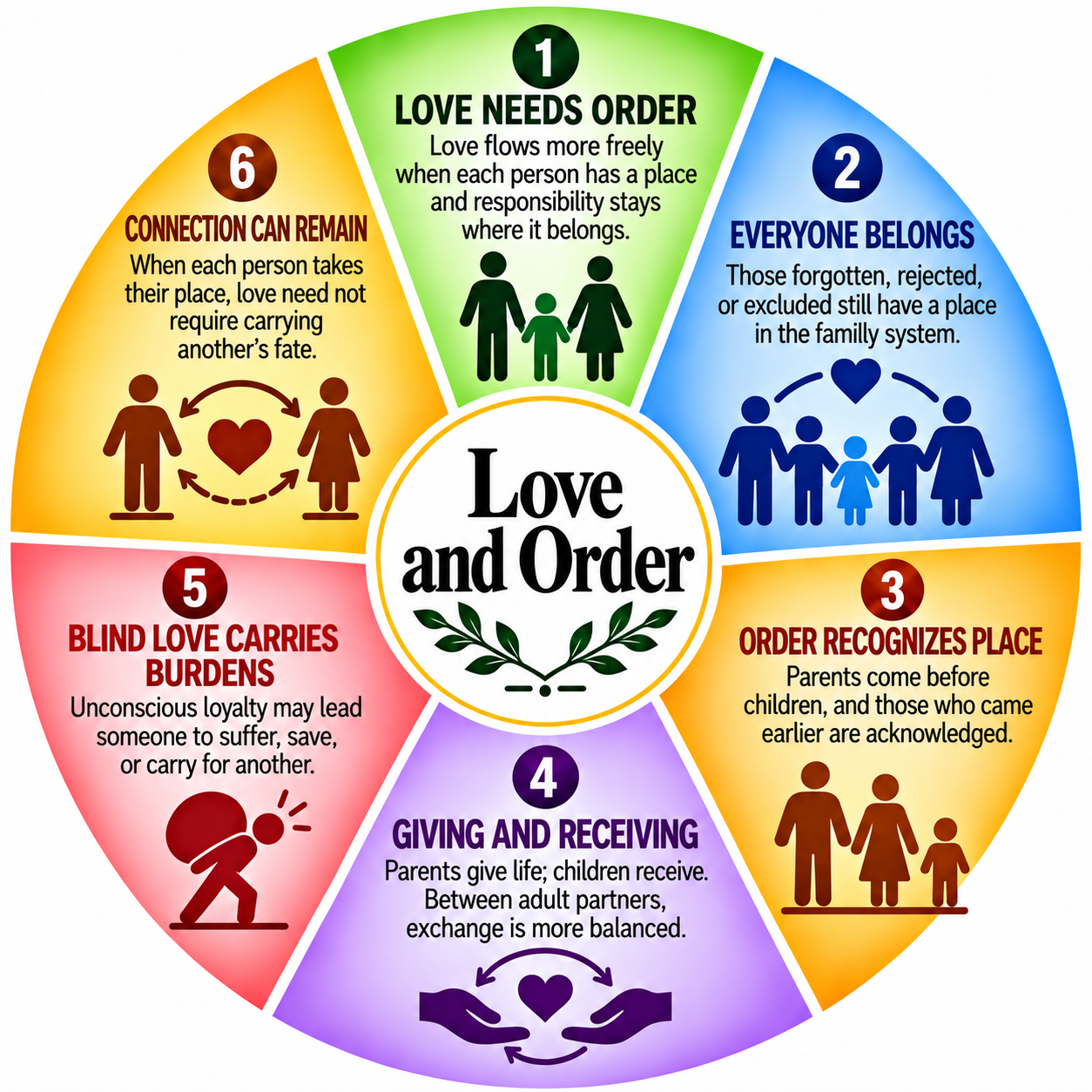
How the Orders of Love Support Healthy Relationships
Belonging
Every member of a family system has a place.
This includes:
parents
children
siblings
former partners
those who died young
family members who were excluded, forgotten, or rejected
From a Family Constellations perspective, exclusion does not remove someone from the family system. Instead, later generations may unconsciously express or carry aspects of what has been left unresolved.
Order
Order recognizes that each person has a unique place within the family.
For example:
Parents come before children.
Older siblings come before younger siblings.
Earlier partners remain part of a person's history.
Respecting order does not require approving of everything that happened in the past. Rather, it involves acknowledging reality and recognizing each person's place within the larger family system.
Giving and Receiving
Giving and receiving take different forms depending on the relationship. Between parents and children, the movement is naturally unequal:
Parents give life.
Children receive life.
As adults, relationships become more reciprocal. Partners often thrive when giving and receiving remain reasonably balanced over time.
When this balance is consistently disrupted, relationships may become strained, one-sided, or emotionally burdensome.
When Love Becomes Blind
In Family Constellations, blind love refers to love expressed through unconscious loyalty rather than conscious choice.
It may be reflected in attitudes such as:
"I will carry this for you."
"I will suffer like you."
"I will save you."
"I will follow you."
These movements usually arise from love and a desire to belong. Yet they can also contribute to emotional burdens and repeating family patterns. Recognizing these unconscious loyalties may open the possibility for a different relationship with the family system.
Children and Family Order
Children are especially sensitive to disruptions within the family system. When important experiences remain hidden, unresolved, or unacknowledged, children may unconsciously attempt to restore balance in ways that exceed their role.
This may be expressed through excessive responsibility, anxiety, difficulty separating from parents, parentification, or repeating familiar family patterns. From a systemic perspective, these responses are often rooted in love and the child's deep need to belong, even when they later create hardship.
Movement Toward Healing with Family Constellations
Movement toward healing becomes possible when love is joined with order. Those who came before are acknowledged, each family member is given their place, parents remain the parents, children remain the children, and responsibility is recognized where it belongs.
In a constellation, unconscious attempts to carry, save, follow, or represent another family member can become visible. When love no longer requires a person to take another’s place or carry another’s burden or fate, connection can remain while each person turns toward their own life.
The Orders of Love are systemic principles used within Family Constellations. They are not moral judgments or universal rules, and they do not explain every difficulty experienced by an individual or family.
About the Author
Barry Krost has been studying Family Constellations since 2003 and has over 40 years of experience in bodywork, somatic education, and systemic healing. He teaches Family Constellations internationally, mentors facilitators through his Training & Certification Program, and has presented at international systemic constellations conferences. His Resource Library reflects decades of professional experience and ongoing study, offering clear, thoughtful, and grounded education to help individuals and professionals better understand Family Constellations.
Explore Further
You may also be interested in:
Ready to explore how these dynamics may be affecting your own life?
Learn about Private Family Constellation Sessions Online or join an Online Group Session.
Frequently Asked Questions
What are the Orders of Love?
The Orders of Love are systemic principles described by Bert Hellinger that emphasize belonging, order, and the balance of giving and receiving within family relationships.
Why is order important in Family Constellations?
From a systemic perspective, recognizing each person's place within the family may help clarify relationship dynamics and reduce patterns that arise from misplaced responsibility or unconscious loyalty.
Does love always need order?
Family Constellations proposes that love often flows more freely when relationships are supported by belonging, appropriate order, and healthy reciprocity. This is a guiding principle of the approach rather than a universal rule.
What is blind love?
Blind love refers to unconscious acts of loyalty in which someone attempts to carry another person's suffering, responsibility, or fate out of love and a desire to belong.
Can Family Constellations help restore order in a family?
Family Constellations does not change the past or guarantee specific outcomes. It may help people recognize systemic patterns and support movements toward greater understanding, balance, and connection within the family system.
