
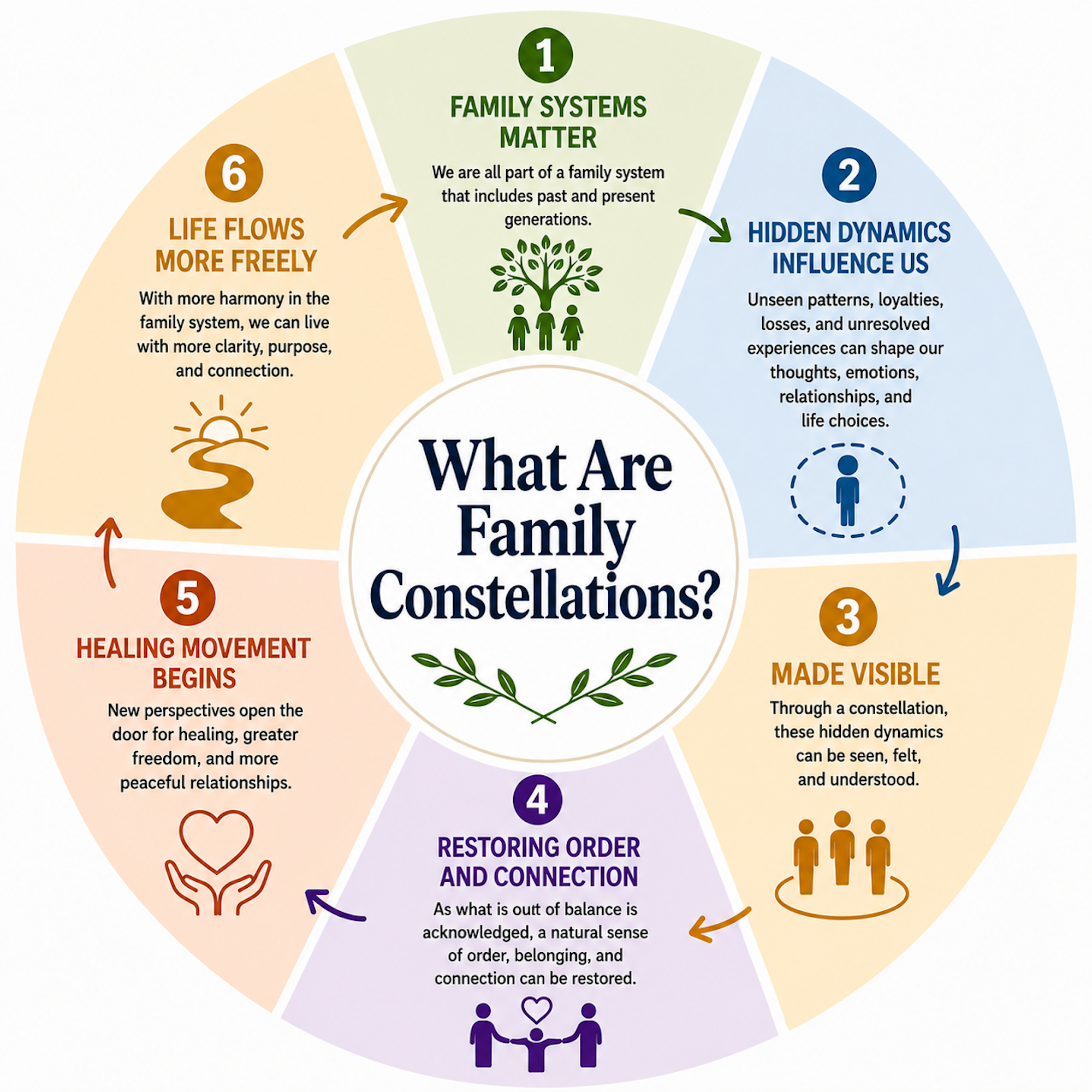
Family Constellation Therapy considers a person’s concern within the relationships and history of their family. Through representatives, objects, or other experiential formats, hidden loyalties, exclusions, entanglements, and interrupted connections can become visible. The facilitator follows what emerges rather than imposing a fixed explanation, allowing the concern to be understood within its particular systemic context.
Introduction
Family Constellation Therapy is a systemic and experiential approach that explores how hidden family patterns may influence emotional well-being, relationships, and repeating patterns across generations.
Many people seek Family Constellations because they sense that something deeper may be influencing their lives. They may experience:
Repeating relationship struggles
Emotional distance from parents
Unexplained fear, shame, or grief
Persistent feelings of exclusion or not belonging
Cycles of addiction or self-sabotage
Difficulty connecting with partners, children, or family members
From a systemic perspective, these experiences may be influenced not only by personal history but also by unresolved trauma, loss, exclusion, interrupted connection, unconscious loyalty, and family experiences that continue across generations.
Family Constellation Therapy offers another way of understanding these patterns while exploring what may support greater awareness, connection, and healing. Family Constellation Therapy is a systemic and experiential approach. It does not replace psychotherapy, medical care, or other appropriate professional support.
Generational Trauma and Emotional Inheritance
Family Constellation Therapy explores how unresolved trauma may continue influencing later generations.
The following experiences may continue affecting emotional and relational patterns within the family system including:
War
Abandonment
Violence
Addiction
Early death
Abuse
Migration
Family separation
Exclusion
Later generations may carry grief that was never expressed, fear that was never resolved, shame connected to earlier events, identification with excluded family members, or unconscious loyalty to family suffering.
As these connections become more visible, people often develop greater understanding of what they may be carrying and what supports healing.
How Hidden Family Patterns Affect Relationships
Even when partners care deeply about one another, earlier family experiences may continue affecting their relationship. A person may long for closeness while withdrawing when it becomes available, find it difficult to receive support, or feel responsible for the other person’s happiness. These responses may have begun in relationships where connection was interrupted or the child took on responsibilities that belonged with an adult.
A present partner may also come to represent someone from the family. The person may look to their partner for the care or recognition they could not receive from a parent, or become connected through the partnership to an earlier loss, exclusion, or family fate. What happens between the partners then includes something that began before their relationship.
A constellation can bring these connections into view. Recognizing the earlier relationship allows attention to turn toward what was missing, what responsibility was assumed, or whose suffering is being carried. The partners can then begin to meet one another more fully as adults, with less of what belongs elsewhere standing between them.
What Happens in Family Constellation Therapy?
A Family Constellation begins with a question, relationship concern, symptom, or recurring pattern the client wishes to explore. After gathering relevant family information, the facilitator helps represent the people and other significant elements connected to that concern. Group participants may serve as representatives; private sessions may use objects, floor markers, or visualization.
As the constellation unfolds, representatives may notice feelings, body sensations, impulses, movements, or shifts in perception. Their positions and responses bring family relationships and systemic dynamics into view. The facilitator attends to what emerges, feeling the dynamics and drawing on insight and intuition rather than deciding beforehand what the constellation should reveal.
A question, an additional representative, a movement, or a healing sentence can respond to what becomes visible. Healing sentences may acknowledge what happened, give someone a place, recognize an important relationship, or clarify what belongs to whom. The process allows understanding and movement to develop without forcing a particular outcome.
What becomes visible during the constellation may continue unfolding afterward. Through integration, the person begins to recognize how that understanding relates to everyday life and relationships. This can take time; the session does not need to provide an immediate answer to everything.
Family Constellation Session Video Demonstration
This short video introduces how family relationships are represented in private and group settings.
The Role of Representatives and Witnesses
One of the distinctive aspects of Family Constellation Therapy is the use of representatives. Representatives are not acting, role-playing, or pretending to be another person. Instead, they simply notice and report their experience while representing a person or another significant element within the constellation.
Representatives may become aware of:
Emotions
Physical sensations
Impulses to move
Feelings of connection or distance
Relationship patterns
Participants who are not serving as representatives become witnesses.
Witnesses observe the constellation with openness and respect, without judgment, interpretation, or analysis. Their presence helps create an environment in which hidden family patterns can become more visible.
Many people find that witnessing or representing in another person's constellation can also provide meaningful insight, as common themes often emerge across different families and life experiences.
Working with Hidden Family Dynamics
Family Constellation Therapy brings family relationships into an experiential form. Through the positions, responses, and movements of representatives, interrupted connection, emotional distance, unresolved grief, and unconscious loyalties can become visible. Participants encounter how relationships within the family system are organized, including connections they had not previously recognized.
The same concern can involve different family relationships. Difficulty receiving support may be connected to responsibility taken for a parent, loyalty to someone who had to manage alone, or an interrupted movement toward a parent. The facilitator follows the relationship that emerges rather than assigning the same explanation to everyone with a similar concern.
As these connections become visible, the person can begin to understand a long-standing difficulty in relation to the people and events involved. Recognizing whose burden they carry, whom they remain loyal to, or where connection was interrupted gives direction to the work.
Movement Toward Healing with Family Constellations
Movement toward healing begins by seeing the family system more fully. People and events that have remained hidden or excluded can be acknowledged, unconscious loyalties and entanglements can become visible, and interruptions in connection can be recognized.
As the relationships within the family become clearer, a person can distinguish their own place, life, and responsibilities from what belongs to parents or earlier family members. The work does not change what happened. It supports a different relationship to the family history and greater freedom to receive life and turn toward what comes next.
Family Constellation Therapy offers a systemic and experiential way of exploring family relationships, recurring patterns, and experiences across generations. It does not assume that every difficulty originates within the family system, and it does not replace psychotherapy, psychiatric or medical care, or other appropriate professional support.
About the Author
Barry Krost has been studying Family Constellations since 2003 and has over 40 years of experience in bodywork, somatic education, and systemic healing. He teaches Family Constellations internationally, mentors facilitators through his Training & Certification Program, and has presented at international systemic constellations conferences. His Resource Library reflects decades of professional experience and ongoing study, offering clear, thoughtful, and grounded education to help individuals and professionals better understand Family Constellations.
Explore Further
You may also be interested in:
Ready to explore how family relationships and patterns may be influencing your own life?
Learn about Private Family Constellation Sessions Online, join an Online Group Session, or Schedule a Complimentary Consultation to discuss the next step that may be right for you.
Frequently Asked Questions
What does Family Constellation Therapy help with?
Family Constellation Therapy may help people explore relationship difficulties, generational trauma, anxiety, depression, emotional disconnection, family conflict, grief, and repeating life patterns from a systemic perspective.
Can Family Constellation Therapy help with generational trauma?
Family Constellation Therapy offers one way of understanding how unresolved trauma, loss, exclusion, and unconscious loyalties may continue influencing later generations and what may support greater awareness and healing.
What happens during a Family Constellation session?
A session begins with a question, concern, or relationship issue the client wishes to explore. Representatives or symbolic methods are then used to represent important elements of the family system, allowing relationships and patterns to become more visible as the constellation unfolds.
What are representatives in Family Constellation Therapy?
Representatives stand in for family members, relationships, symptoms, or other significant elements within a constellation and report their experience as the process unfolds.
What is the role of witnesses?
Witnesses observe the constellation respectfully without judgment or analysis. Many people gain valuable insight simply by witnessing the work of others.
Do I need to know my family history?
No. Detailed family history is not required. Often the most relevant dynamics emerge during the constellation process itself.
Is Family Constellation Therapy evidence-based?
Research into Family Constellation Therapy continues to develop. Existing studies have explored its potential effects and limitations, while further research is needed to better understand its effectiveness.
Can Family Constellation Therapy help relationships?
Many people use Family Constellation Therapy to explore recurring relationship patterns, emotional distance, family loyalties, intimacy, and questions of belonging.
How do I begin?
You can begin with a private session, group session, workshop, or training program, depending on your interests and goals.
Can Family Constellation Therapy be done in an individual session?
Yes. While Family Constellation Therapy originally developed as a group process, it is also widely offered in private one-on-one sessions. Objects, floor markers, or visualization can be used to represent family relationships and explore recurring patterns.
How many Family Constellation sessions do I need?
There is no standard number of sessions. Some people gain meaningful insight from a single constellation, while others return over time as new themes emerge or as they continue integrating what they have learned into their lives.
