
Parentification occurs when a child assumes responsibilities or a position that belongs with an adult. Becoming a caretaker, confidant, or protector can preserve connection while leaving the child’s own needs unanswered. Family Constellations considers the love and loyalty beneath this position, and how responsibility for a parent can continue through guilt, overgiving, or difficulty receiving support in adult life.
Introduction
Some children grow up feeling responsible for their parents or for holding the family together.
Instead of simply being children, they gradually become caretakers, confidants, peacemakers, protectors, or “the strong one” in the family.
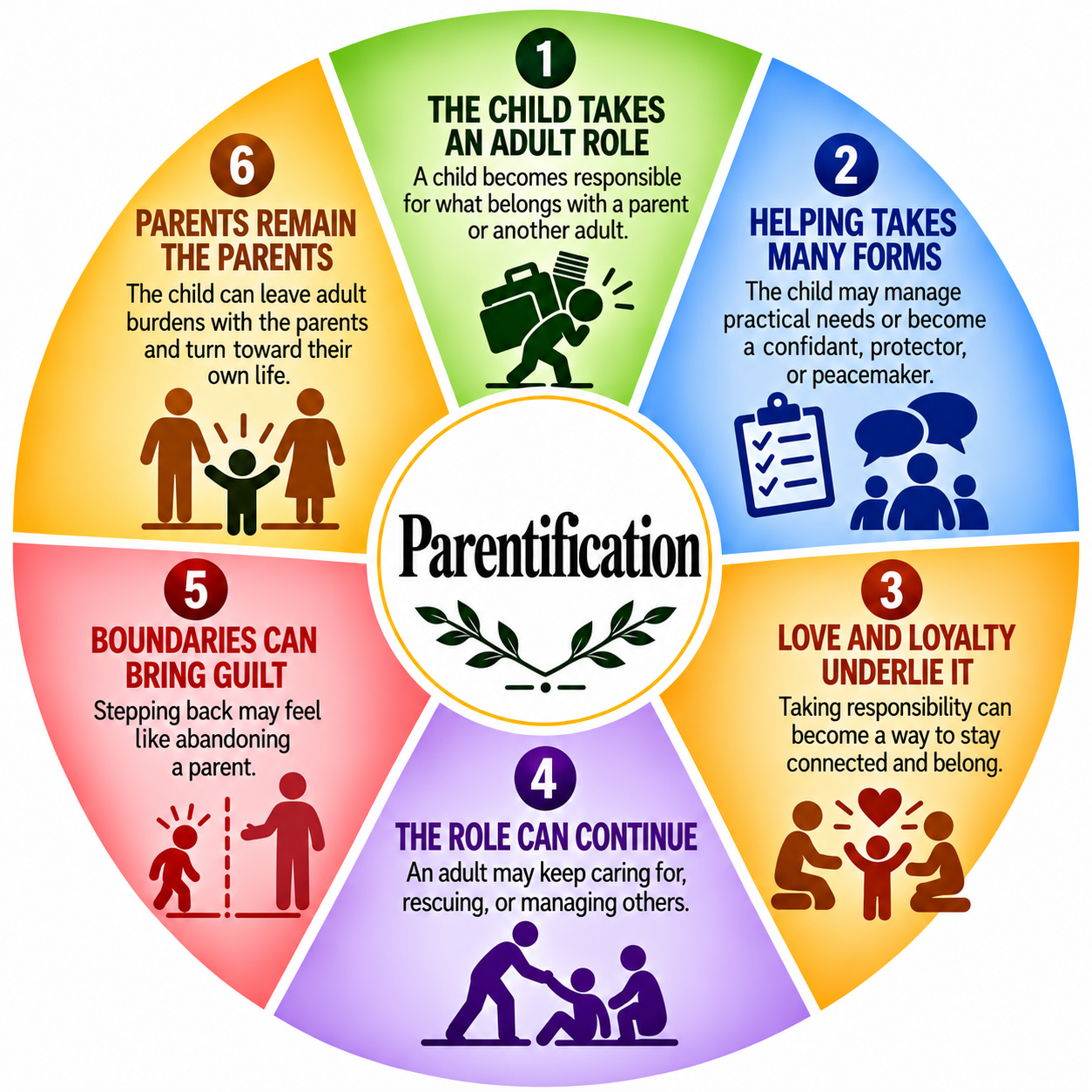
Parentification occurs when a child takes on practical or relational responsibilities, functions, or a position that belongs with a parent or another adult.
The child may appear mature, capable, responsible, or unusually caring while carrying responsibilities that are too large for them. This responsibility may continue long after childhood has ended.
Family Constellations offers one way of understanding how this reversal of roles may continue influencing identity, boundaries, adult relationships, and the ability to receive support.
What Is Parentification?
The defining feature of parentification is not simply that the child helps. The child becomes responsible for something that belongs with a parent or another adult and is too large or inappropriate for them to carry.
Children can contribute to family life by helping with household tasks, caring for younger siblings in appropriate ways, and sharing responsibilities suited to their age. These contributions do not become parentification when the adults remain responsible for the children and the family’s stability
The Natural Order Between Parent and Child
In healthy family systems, parents give and children receive. Children naturally depend on their parents for safety, nourishment, protection, guidance, care, and connection to life.
The child is strengthened through receiving from their parents.
The child’s place is not to rescue the parent or become responsible for the parent’s life. When a child assumes responsibilities that belong with the parent or another adult, the order between parent and child becomes disturbed. Instead of receiving support, the child becomes focused on providing it.
The parent remains responsible for their own life, relationships, and fate. The child can remain connected to the parent without becoming responsible for what belongs with them.
Practical and Relational Forms of Parentification
Parentification may involve practical responsibilities, relational responsibilities, or both.
Practical parentification occurs when a child assumes responsibilities that should remain with a parent or another adult. The child may become responsible for caring for siblings, managing household needs, responding to adult problems, or keeping the family functioning in ways that are not appropriate for their age.
Relational parentification occurs when the child becomes the parent’s confidant, peacemaker, protector, stabilizer, or primary source of support. The child may listen to problems belonging between adults, mediate family conflict, or take a place in relation to the parent that belongs with another adult.
In either form, the child is no longer simply contributing to family life. They have become responsible for something that should be carried by the adults.
How Parentification Develops
Parentification may develop when a family is affected by addiction, illness, divorce, conflict, grief, financial strain, the absence of a parent, or difficult events within the family history. A parent may be overwhelmed by their own life or unable to fully take their place as the parent.
Sometimes the child assumes the responsibility openly because practical needs are not being met. At other times, the role develops quietly as the child begins responding to the parent’s struggles or trying to preserve the family’s stability.
Parents do not necessarily intend for the child to take on this position. The child may gradually recognize that being helpful, capable, quiet, protective, or undemanding allows them to support the parent or respond to what is happening within the family.
Most children do not consciously choose this role. The responsibility develops within circumstances the child did not create and cannot resolve.
Love, Loyalty, and the Need to Belong
Children rarely become responsible for their parents through conscious choice. The responsibility often begins in love, loyalty, and the child’s need to remain connected and belong within the family.
A child may unconsciously feel:
“I need to help.”
“I need to protect my parent.”
“If I do enough, things will be okay.”
“I cannot burden them further.”
When a child’s reaching toward a parent is interrupted or not fully received, becoming helpful or responsible can become one way of continuing to reach toward the parent and preserve connection.
For some children, this responsibility becomes especially connected to the mother. The child may try to protect her, make her happy, ease her loneliness, or give her something she did not receive. In this way, responsibility for the mother’s happiness may become connected to the child’s continuing need to reach toward her and be received.
Recognizing the love and loyalty beneath parentification does not make the responsibility appropriate or minimize its consequences for the child. The child has taken on something that belongs with the parent or another adult.
The Role Taken by the Child
When a child repeatedly steps in to help, being capable, protective, strong, or needed may gradually become their place within the family. Their attention turns toward what the parent or family needs rather than remaining free to receive care and support as the child. The family may come to rely on the child's strength and helpfulness even though the responsibility remains too large for them.
In Family Constellations, a child who assumes responsibilities belonging to the parent or another adult is sometimes understood as becoming “too big.” This does not refer to the child’s age, competence, or maturity. It describes a reversal of place in which the child assumes an adult position within the family.
From this position, the child may try to protect the parent, make decisions for them, prevent difficulties, or take responsibility for what happens to them. What begins as an expression of love and loyalty can become an ongoing responsibility that belongs with the parent rather than the child.
The parent remains the parent, and the child remains the child. The child does not need to become responsible for the parent in order to have a place or belong within the family.
Why Do I Feel Responsible for My Parents?
The responsible position taken during childhood does not automatically end The responsible position taken during childhood does not automatically end when the child becomes an adult. If helping, protecting, or holding things together became the child’s place within the family, they may continue feeling responsible even after the original circumstances have changed.
An adult may feel responsible for a parent’s happiness, loneliness, health, finances, relationships, decisions, or what happens as the parent ages. They may watch the parent for signs that something is wrong and feel compelled to step in whenever the parent struggles.
The responsibility may also extend beyond the parents. A person may feel responsible for siblings, partners, friends, coworkers, clients, or anyone who appears to need help. They may become the one who anticipates problems, intervenes, and keeps things functioning.
The people may change, but the responsible role remains. What began as the child’s place within the family can become the position from which they meet many areas of adult life.
Guilt, Separation, and Boundaries
Parentification is often deeply connected to guilt. Saying no, setting a boundary, becoming independent, or stepping back from responsibility may feel like hurting or abandoning the parent.
When being helpful or responsible has become the child’s place within the family, giving up that responsibility can feel like threatening the connection itself. The adult may understand that they cannot be responsible for the parent’s life and still feel, “If I stop carrying this, what will happen to you?”
A child may also feel that becoming freer, happier, or more successful than the parents would be disloyal. They may unconsciously feel:
“If I separate, I abandon them.”
“If I have more than my parents had, I betray them.”
“I must remain connected through responsibility.”
From a systemic perspective, this guilt can accompany movement away from an earlier family role. It does not necessarily mean that the boundary or separation is wrong.
Leaving with parents what belongs to them does not mean rejecting them, abandoning them, or refusing all responsibility toward them. Connection can remain while the parents retain responsibility for their own lives and the adult child takes responsibility for theirs.
The Cost to the Child
Although parentified children may appear mature, capable, or highly responsible, carrying an adult responsibility can come at a considerable cost. The child’s attention becomes directed toward the parent or family, leaving less room for their own needs, wishes, development, and experience.
Their life may gradually become organized around helping, fixing, protecting, caretaking, and remaining needed by others. They may become highly attentive to what others need while struggling to recognize what they need or want for themselves.
This can contribute to continuing pressure, exhaustion, loneliness, difficulty relaxing, and a persistent sense of responsibility. Receiving care or support may also be difficult because the child became accustomed to giving rather than receiving.
Parentification and Adult Relationships
Adults who were parentified may continue the responsible role in later relationships. They may over-function, take greater responsibility for maintaining the relationship, become uncomfortable depending on a partner, or struggle to allow giving and receiving to become more balanced.
Within a partnership, the person may feel responsible for the partner’s well-being, decisions, or difficulties. They may begin caring for, protecting, correcting, or rescuing the partner as though the partner were a child who could not manage their own life.
Partners meet as adults, and each remains responsible for their own life and fate. When one partner takes the parental position and the other is treated as the child, the balance between them becomes disturbed.
Recognizing the earlier family role can make visible that the partner is neither the parent who once needed help nor a child who must be cared for. The responsibility taken in the family of origin does not need to determine the person’s place within an adult partnership.
Caring for Aging Parents Without Losing Your Place
Caring for an aging, ill, disabled, or vulnerable parent is not automatically parentification. An adult child may appropriately take substantial responsibility for finances, appointments, housing, daily care, or decisions the parent can no longer manage alone.
Practical responsibilities can change while the order remains. The parent remains the parent, and the child remains the child, even when the adult child provides significant care or makes necessary decisions. Providing help does not require taking responsibility for the parent’s entire life, happiness, relationships, or fate.
For someone who took an adult place during childhood, a parent’s genuine need for assistance can draw them back into that earlier position. Recognizing the difference allows them to respond to the parent’s actual needs while remaining in their own place and attending to their own life and relationships.
Parentification and Carrying a Parent’s Pain
Parentification and carrying a parent’s pain can overlap, but they are not the same.
Parentification occurs when the child takes on a practical or relational responsibility, function, or position that belongs with a parent or another adult. Carrying a parent’s pain involves identification or entanglement with the parent’s suffering, burden, or fate.
A child may carry something connected to a parent’s grief, loss, guilt, or difficult history without becoming the parent’s caretaker or assuming an adult role. Conversely, a child may become responsible for the parent or family without carrying the parent’s suffering.
The separate article When Children Carry Their Parents’ Pain provides a fuller explanation of identification and entanglement with parental suffering.
Movement Toward Healing with Family Constellations
Movement toward healing begins with recognizing the position the child took within the family and the love and loyalty beneath it. A constellation can make visible where the child became “too big,” what responsibility or function they assumed, and what belongs to the parents or elsewhere within the family.
When the parents are allowed their dignity, responsibilities, and fate, the child no longer has to hold the family together, protect a parent, or carry what belongs to the adults. The parents remain the parents, and the child can return to their place as the child.
This does not prevent an adult child from providing necessary care to an aging, ill, disabled, or vulnerable parent. Practical responsibilities may change, but the order between parent and child remains. The adult child can respond to present needs without becoming responsible for the parent’s happiness, suffering, relationships, or fate and can turn more fully toward their own life and relationships.
Healing Sentences
Within a Family Constellation, possible healing sentences may include:
“Dear Mom/Dad, this is too much for me.”
“I leave this responsibility with you, with respect.”
“You are the big one, and I am the little one.”
“I am only your child.”
About the Author
Barry Krost has been studying Family Constellations since 2003 and has over 40 years of experience in bodywork, somatic education, and systemic healing. He teaches Family Constellations internationally, mentors facilitators through his Training & Certification Program, and has presented at international systemic constellations conferences. His Resource Library reflects decades of professional experience and ongoing study, offering clear, thoughtful, and grounded education to help individuals and professionals better understand Family Constellations.
Explore Further
You may also be interested in:
Ready to explore how parentification or responsibility toward your parents may be affecting your life?
Schedule a Complimentary Consultation to discuss whether Family Constellations may be right for you.
Frequently Asked Questions
Why do I feel responsible for my parents?
Responsibility for parents may continue when helping, protecting, or holding the family together became the child’s place. Even after the original circumstances change, the adult may continue feeling responsible for the parents’ happiness, difficulties, or well-being.
What is parentification?
Parentification occurs when a child takes on practical or relational responsibilities, functions, or a position that belongs with a parent or another adult.
What is the difference between parentification and age-appropriate responsibility?
Children can contribute to family life without becoming responsible for the parents or the family’s stability. Parentification occurs when the child assumes an adult responsibility or becomes responsible for something too large or inappropriate for them to carry.
Why do I feel responsible for my mother’s happiness?
Responsibility for the mother’s happiness may begin as an attempt to help, remain connected, or continue reaching toward her. Being helpful or needed can then become the child’s place in relation to the mother.
Why can setting boundaries with parents create guilt?
When responsibility has become connected to belonging, saying no or stepping back may feel like abandoning or betraying the parent. The guilt may continue even when the responsibility belongs with the parent.
Can someone care for aging parents without becoming parentified?
Yes. Adult children may appropriately provide substantial care for aging, ill, or vulnerable parents. The difficulty arises when the adult child becomes responsible for the parent’s entire life or abandons their own needs, relationships, and place as the child.
Can parentification affect adult relationships?
Yes. The responsible role may continue with partners and others. A person may over-function, assume responsibility for the relationship, or treat another adult as someone who must be cared for, protected, corrected, or rescued.
What is the difference between parentification and carrying a parent’s pain?
Parentification involves assuming an adult position, function, or responsibility. Carrying a parent’s pain involves identification or entanglement with the parent’s suffering, burden, or fate and can occur without the child becoming a caretaker.
Can Family Constellations help with parentification?
Family Constellations provides one way of exploring the roles, responsibilities, and loyalties connected to parentification. It may bring into view where the order between parent and child became disturbed and what responsibility belongs with the parents or elsewhere in the family.
