
Recurring grief, fear, over-responsibility, or relationship difficulties can invite questions about earlier family experiences. Similar patterns across generations, silence around significant events, or guilt about living differently may draw attention to unresolved family history. Family Constellations considers the people, losses, exclusions, and unconscious loyalties through which earlier suffering may remain connected to present life.
Introduction
Many people sense that some of their emotional struggles, relationship difficulties, or recurring life patterns feel larger than their own life experience. They may notice similar challenges appearing across generations of their family, such as anxiety, addiction, emotional distance, chronic conflict, abandonment, depression, caregiving roles, persistent fear or instability, or unresolved grief. These recurring patterns can leave people wondering whether something from the past continues to influence the present.
Family Constellations explores how trauma and unresolved family experiences may continue influencing later generations through emotional, relational, and nervous system patterns.
This does not mean people are trapped by the past. Rather, it suggests that unresolved experiences may continue shaping family patterns until they are acknowledged with greater awareness, connection, and balance.
What Is Generational Trauma?
Generational trauma describes how the effects of overwhelming experiences may continue within a family beyond the lives of those directly affected. War, persecution, violence, displacement, abandonment, or an early death can affect how family members relate, what they speak about, and what later generations learn about safety, responsibility, and belonging.
Within Family Constellations, attention also turns toward identification, entanglement, and unconscious loyalty. A descendant may become connected to someone who suffered, was excluded, or could not fully turn toward life after a loss. The descendant may share something of that person’s suffering or repeat a limiting movement without knowing whom it connects them to.
A person may feel guilty enjoying a secure life when earlier family members endured deprivation, or remain withdrawn through loyalty to someone whose grief was never acknowledged. These examples show the kinds of connections explored in a constellation. Anxiety, guilt, withdrawal, or a repeating relationship does not by itself establish such a connection; the particular people and relationships involved need to come into view.
How Earlier Experiences Continue Within a Family
Children also grow up within the relationships and circumstances shaped by earlier events. A parent who remains caught in grief may find it difficult to receive a child. A family that survived persecution may continue living with fear or silence. Children can learn ways of responding and take on responsibilities within these relationships long before they understand the history behind them.
Learning within a family and systemic identification are different ways an earlier experience can continue. A descendant may become identified with someone who was excluded or remain loyal to a loss without knowing the person or event involved. The work follows the particular connection that becomes visible.
Recognizing Recurring Patterns
Anxiety, grief, shame, over-responsibility, withdrawal, or repeating relationship difficulties can raise questions about family history. The systemic questions are specific: whose suffering is being carried, who has been left out, what responsibility continues, or where was connection interrupted?
These experiences have many possible influences. Their presence alone does not establish an ancestral connection. The visual map below shows areas of life in which generational influences may become relevant and provides a starting point for exploring the people, events, and relationships involved.
What a Recurring Pattern Invites Us to Explore
A pattern becomes relevant to this exploration when it raises a question about family relationships or history: whose suffering is repeated, what role continues, which person is absent from the story, or where connection was interrupted. Similar experiences across generations invite attention without establishing a single cause.
The visual map below brings together the areas of life in which these questions may arise. It is a guide to exploration, not a way to determine whether someone carries generational trauma.
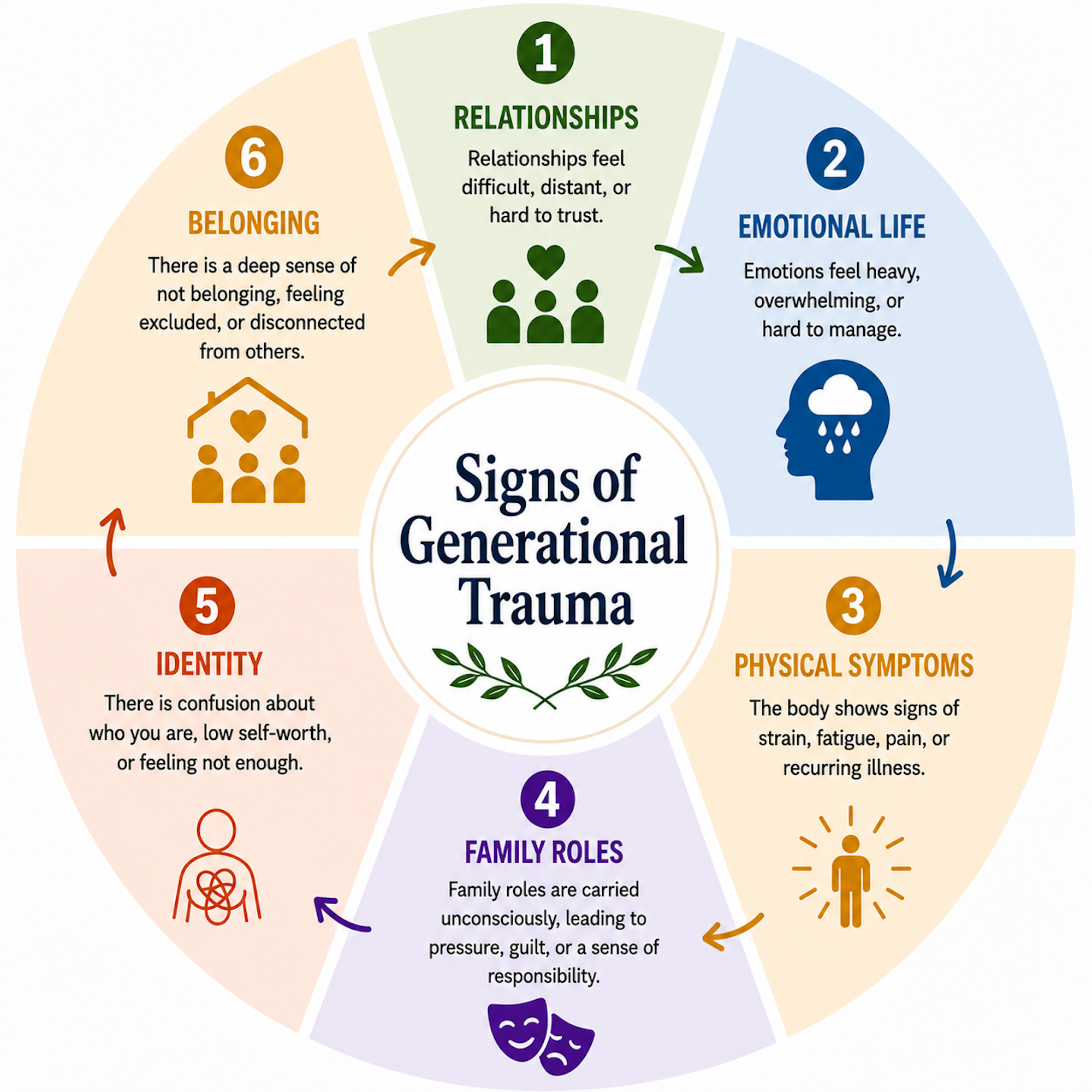
Common Signs of Generational Trauma
Generational trauma may appear in many different ways. No single sign proves that unresolved family trauma is present, and many of these experiences have multiple emotional, psychological, biological, social, and cultural causes.
From a Family Constellations perspective, however, recurring patterns may sometimes reflect the ways individuals and families have adapted to unresolved experiences across generations.
Emotional and Nervous System Responses
Some people experience persistent patterns of anxiety, emotional overwhelm, or disconnection that seem difficult to explain through present circumstances alone.
This may include:
Chronic anxiety
Ongoing tension
Fear or hypervigilance
Difficulty relaxing
Emotional flooding
Panic
Emotional shutdown or numbness
Chronic stress activation
Difficulty settling after conflict
The nervous system may remain organized around survival even when present-day circumstances are safer than those that originally shaped these responses.
Relationship Patterns
Generational trauma may also influence how people experience relationships throughout life.
This may appear as:
Difficulty trusting others
Fear of abandonment
Emotional distance
Difficulty maintaining healthy boundaries
Repeated conflict
Emotionally unavailable relationships
Caregiving dynamics
Unstable partnerships
Cycles of closeness and withdrawal
People often find themselves longing for connection while simultaneously fearing vulnerability or intimacy. These relationship patterns can feel automatic because they developed as adaptations within earlier family relationships.
Carrying More Than Your Own
Children growing up in traumatized family systems sometimes become emotionally or practically responsible for others.
This may later appear as:
People-pleasing
Chronic guilt
Perfectionism
Over-responsibility
Fear of disappointing others
Becoming a caretaker or rescuer
Difficulty relaxing
Difficulty receiving support
This movement is often described as parentification, where children gradually assume responsibilities that more naturally belong to parents or other adults.
Many individuals unconsciously organize their lives around carrying the emotional well-being of others. These patterns often continue into adulthood, influencing identity, boundaries, self-worth, and relationships.
Living Under the Shadow of Earlier Trauma
Some people also experience patterns such as:
Addiction or compulsive behaviors
Self-sabotage
Persistent grief
Emotional heaviness
Depression
Fear of success
Difficulty receiving abundance or support
From a Family Constellations perspective, these experiences may sometimes reflect attempts to regulate overwhelming emotional states or unconscious loyalty to unresolved suffering within the family system.
Not everyone who experiences these challenges is carrying generational trauma. They may arise from many different life experiences and influences. Family Constellations simply invites us to consider whether unresolved family experiences may also be contributing to these recurring patterns.
Silence and Family Secrets
Some families avoid speaking about a death, separation, act of violence, hidden relationship, or person who was rejected. The silence may have begun because what happened was overwhelming, dangerous to disclose, or connected with shame. Children may sense that something matters without knowing what occurred.
They may learn not to ask questions, mention a particular person, or acknowledge what others seem determined to forget. Protecting the silence can become a way of remaining loyal to the family. Later, speaking or looking more closely may feel like betrayal, even when the circumstances that first made silence necessary have passed.
Family Constellations also considers whether a later family member has become identified with someone whose place or suffering was concealed. Loyalty to the silence and identification with that person are different connections, although both may be present. Forbidden subjects and strong reactions invite attention, but they do not establish what happened. Known people and events can be acknowledged while missing details remain unknown.
Unconscious Loyalty
Family Constellations often understands repeating suffering through the lens of unconscious loyalty. Children naturally love their families long before they understand them, and that love can become a deep, unconscious loyalty. At times, this loyalty may be expressed by carrying emotional burdens, repeating patterns, or remaining connected to family suffering in ways that are outside conscious awareness.
Without realizing it, a person may unconsciously feel:
"I will carry this for you."
"I will suffer like you."
"I will not have more than you."
"I will remain connected through pain."
These movements are rarely conscious decisions. Rather, they can be understood as expressions of a child's deep need for love, belonging, and connection within the family system. From this perspective, behaviors that appear self-defeating may sometimes represent unconscious attempts to remain connected to those who came before.
Honoring the Past Without Repeating It
Recognizing a pattern is the beginning of a question, not a conclusion about its source. A constellation explores the known history and the relationships that become visible rather than identifying an ancestral event from a feeling or symptom alone.
Where a loyalty or entanglement becomes visible, the earlier people and their circumstances are acknowledged. Their suffering and fate can have their own place without a descendant continuing to represent or repeat them. The movement follows the particular relationship that emerges; it is not determined by a checklist of signs.
About the Author
Barry Krost has been studying Family Constellations since 2003 and has over 40 years of experience in bodywork, somatic education, and systemic healing. He teaches Family Constellations internationally, mentors facilitators through his Training & Certification Program, and has presented at international systemic constellations conferences. His Resource Library reflects decades of professional experience and ongoing study, offering clear, thoughtful, and grounded education to help individuals and professionals better understand Family Constellations.
Explore Further
You may also be interested in:
What Is Inherited Family Trauma?; Why Family Patterns Repeat Across Generations; Anxiety and Family Constellations; Entanglements in Family Systems
Ready to explore how these dynamics may be affecting your own life?
Learn about Private Family Constellation Sessions Online or join an Online Group Session.
Frequently Asked Questions
What is generational trauma?
Generational trauma refers to unresolved emotional, relational, or nervous system effects that continue influencing later generations within a family system.
What are common signs of generational trauma?
Common signs may include anxiety, relationship difficulties, over-responsibility, emotional numbness, repeating patterns, chronic stress, addiction, unresolved grief, and difficulty feeling connected.
Can trauma affect people who did not directly experience it?
Yes. Emotional patterns, family roles, nervous system responses, and relationship dynamics may continue influencing later generations even when the original events are no longer discussed.
Why do unhealthy family patterns repeat?
Families often repeat unresolved emotional dynamics through belonging needs, unconscious loyalty, family roles, nervous system conditioning, and learned relationship patterns.
Can Family Constellations help reveal generational trauma?
Family Constellations may help bring unconscious family patterns, loyalties, exclusions, and unresolved dynamics into greater awareness.
Does generational trauma mean I am destined to repeat my family's history?
No. Understanding family patterns can create greater awareness, choice, connection, and freedom to develop new ways of relating to yourself and others.
Can healing occur even if I do not know my family history?
Often yes. Many people begin recognizing patterns through their own experiences, relationships, and emotional responses even when little information is available about earlier generations.
