
Estimated Reading Time: 20–25 minutes
By Barry Krost
Families inherit more than the suffering and losses of earlier generations. They also inherit ways of surviving that continue to influence how they relate to one another, raise their children, and participate in life. Adaptations that once preserved survival and belonging can become obstacles to the giving and taking that sustains families across generations. What helped one generation survive can leave another stuck in survival.
Key Points
The instinct to be received: From birth, we need to be safe, seen, loved, and nourished to survive. Belonging and experiencing belonging are different.
What stands between parent and child: Unresolved suffering and relationships from earlier generations can prevent parents from fully receiving their infants.
Survival adaptations: When children cannot reach their parents and be fully received, they adapt to preserve closeness and experience belonging.
Unconscious loyalty and entanglement: Children can become loyal to what prevents them from being received or entangled with the suffering and fate of family members and ancestors.
Disturbed giving and taking: These loyalties disturb healthy giving and taking, restricting what parents can give their children and what children can take and eventually pass to the next generation.
Families stuck in survival: When survival adaptations become fixed through unconscious loyalties and entanglements, later generations remain organized around earlier suffering.
Being received by the wider family: Our need to be received extends beyond our parents. Family members and ancestors offer love, strength, and groundedness that support giving and taking across generations.
Surviving and thriving together: Taking from our families and ancestors allows us to participate more fully in life without continuing to carry earlier suffering.
The Family as a Living System of Giving and Taking
Every family belongs to a much larger history of people whose giving and taking made life possible for those who followed. Our existence depends upon countless people who survived, formed relationships, raised children, and passed life from one generation to the next.
Survival has always depended upon relationships. Each generation receives life from those who came before and depends upon the care, protection, knowledge, and support of others. Through this giving and taking, families sustain life and make it possible for those who follow to survive.
Within families, giving and taking follow a particular order. Parents give life, nourishment, protection, and love, while children take what their parents give. As children grow, what they have taken becomes available for their own lives, their relationships, and eventually their children. Through this movement, life continues across generations.
Families also carry the consequences of losses, violence, exclusion, and unresolved suffering. These experiences influence what parents can take from their own families and what becomes available to their children. When earlier suffering continues to interfere with giving and taking, the consequences extend beyond those who originally experienced it.
The question is how these family histories become part of the lives of children born generations later.
The Instinct to Be Fully Received at Birth
Every child comes into life with an instinctive movement toward being received. From birth, an infant depends upon others for survival, nourishment, protection, and love. The baby reaches toward the mother with an expectation of being received, of finding a place where they are safe, seen, loved, and nourished.
We can observe something of this instinct in the movements of a newborn. When placed on the mother's body after birth, a newborn can gradually move toward the breast, guided by instinctive behaviors that support feeding and contact. This movement offers a visible expression of reaching toward the person upon whom the baby's life depends.
The need to be received extends beyond physical care and the immediate relationship with the mother. Every baby is born into a family system that existed long before their arrival. They belong by birth among parents, siblings, grandparents, other relatives, and generations of ancestors. This belonging does not have to be earned. But belonging and experiencing that belonging are not the same.
Throughout human history, particularly in hunting and gathering societies, children have depended upon people beyond their parents for care, nourishment, protection, and survival. Their instinctive need to be received is not limited to the mother, even though the relationship with her is fundamental. Fathers, siblings, grandparents, other relatives, and people surrounding the family offer different possibilities for experiencing being received and feeling safe and protected among those to whom they belong.
Being born into a family establishes belonging. Experiencing that belonging depends upon what becomes possible within the relationships that receive us.
What Stands Between Parent and Child?
A parent can love a child deeply and still be unable to fully receive them. The difficulty does not necessarily arise from the child's needs or behavior. Something from the parent's own family history can stand between them.
A mother or father can remain bound to a parent who suffered, a sibling who died, someone who was excluded, or an unresolved relationship from an earlier generation. Their attention remains directed toward that person or experience, even while they care for and raise their own children. What remains unresolved in the parent's family interferes with what becomes available in the present.
Infants enter these relationships without knowing their history. They experience the parent's presence, attention, suffering, and limitations without understanding what lies behind them. What stands between baby and parent can be experienced as part of the parent themselves.
This distinction matters. The infant is reaching toward the parent, not toward the obstruction. But when the parent's suffering or unavailability is inseparable from the baby's experience of them, the attempt to remain close becomes shaped by what stands between them.
How Parents and Children Respond
When something stands between parents and children, they adapt in different ways to preserve closeness and experience belonging. Some reach more strongly toward the parent, becoming especially attentive to their needs. Others become quiet, withdraw, avoid making demands, or partially turn away. These different responses arise within the same fundamental need to remain close, safe, loved, and nourished.
Infants cannot understand the family histories that influence their parents. They experience what is available and what is missing without knowing why. As babies grow into young children, they adapt to the relationships upon which their lives depend. Their instinct to be received remains, even when their outward behavior appears to move in another direction.
A young child can turn away from a parent as a way of remaining close. There can be a no and a yes at the same time: a no to what is painful, unavailable, or overwhelming, and a deeper yes to the parent. Turning away does not necessarily mean rejecting the parent or abandoning the need to be received. The movement can protect the relationship while preserving a form of closeness.
Children can also experience the difficulty as something wrong with themselves. A young child who cannot understand why a parent is unavailable can conclude that they are not good enough, have done something wrong, or must become different to be loved. Instead of recognizing what stands between them and the parent, they take responsibility for something beyond their ability to change.
Parents also respond from within their own family histories. A mother or father whose attention remains directed toward earlier suffering can struggle to be fully available to their children. The parent continues living within the consequences of their own adaptations, while their children develop responses to the circumstances they encounter.
Neither parent nor child needs to recognize these movements for them to influence the relationship. What begins as a response to the circumstances of childhood can become an enduring way of maintaining closeness and experiencing belonging.
Unconscious Loyalty and Entanglement as Adaptations
An adaptation that helps a young child remain close to a parent can develop into an unconscious loyalty. When a parent remains bound to earlier suffering, the child can become loyal not only to the parent but also to what the parent carries. Sharing that suffering becomes a way of maintaining closeness and experiencing belonging.
Bert Hellinger described how children, through blind love, attempt to share the suffering of someone they love or carry a burden that belongs to another family member. The inward movement can be expressed as "Better me than you." Through this loyalty, children attempt to relieve someone else's suffering or remain close to a person whose fate has been difficult. The movement expresses love, but it cannot resolve what belongs to another person.
These loyalties extend beyond parents. An entanglement occurs when someone becomes identified with another family member's suffering or fate, particularly a person who has been excluded, forgotten, or whose place has not been fully acknowledged. A descendant can become bound to an ancestor who suffered, someone who died, or a victim or perpetrator from an earlier generation. Through this identification, a person continues carrying something that belongs to someone else.
A young child can also become loyal to what stands between them and a parent. When a mother remains bound to the suffering of her own mother, her child can attempt to share that suffering as a way of remaining close to her. The child is not consciously choosing the obstruction. What the mother carries has become part of the child's experience of her, and sharing it preserves a form of closeness even as it restricts what the child can take from others.
Not every childhood adaptation becomes an entanglement. Becoming quiet, helpful, watchful, or withdrawn can be a response to difficult circumstances without involving identification with another family member. Unconscious loyalty and entanglement concern a deeper relationship with someone else's suffering, exclusion, responsibility, or fate. They can develop in connection with difficulties in being fully received, but they also arise through other relationships and events within the family system.
These loyalties can preserve an experience of belonging while restricting a person's freedom to live differently. A descendant identified with an excluded ancestor can continue living in relation to that person's fate rather than taking fully from the possibilities available in their own life. The loyalty preserves a sense of closeness, but the suffering it carries does not belong to the descendant.
When Giving and Taking Become Disturbed
When children attempt to carry suffering that belongs to their parents or earlier family members, they begin taking responsibility for what is not theirs. This disturbs the order of giving and taking between parents and children. Children do not have to repay their parents for what they have received. What they take becomes available to carry forward into their relationships and, eventually, to their own children.
When a young child becomes concerned with a parent's suffering or happiness, this movement can reverse. Instead of taking what is available, the child attempts to give what the parent needs. They become helpful, protective, or responsible for difficulties that belong to the parent or someone from an earlier generation. What appears to be care can also be an attempt to preserve closeness and experience belonging.
Parents can participate in this reversal without recognizing it. A mother or father who has difficulty taking from their own parents can turn toward a child for companionship, reassurance, or emotional support. Both experience closeness through the arrangement, although that closeness does not mean the child is being fully received. The young person occupies a place that belongs to an adult, while their own needs remain insufficiently attended to.
Loyalty to one parent can also restrict what children take from the other. When a daughter remains loyal to her mother's suffering or rejection of the father, turning toward him can feel like turning away from her mother. She remains close to one parent at the cost of taking what is available from the other and that parent's family. Her belonging to both remains unchanged, even when her ability to experience that belonging is restricted.
These disturbances extend beyond individual relationships. When parents cannot take support from others and children become occupied with what their parents carry, the family's capacity for giving and taking becomes restricted. What could support the present generation is drawn into earlier suffering, leaving less available to carry forward.
When Survival Continues Into Adulthood
The adaptations that helped us survive childhood do not necessarily end when we become adults. We no longer depend upon our parents for survival in the same way, but the ways we learned to maintain closeness and experience belonging can continue influencing our relationships, choices, and ability to take what life offers.
Adult life presents possibilities that were unavailable in childhood. We can develop relationships, find support, and make choices beyond the circumstances in which we grew up. But taking these opportunities can feel like leaving someone behind. A person who remains loyal to a parent's suffering or an ancestor's difficult fate can experience freedom, happiness, or success as a departure from those they love.
These loyalties take different forms. Someone whose mother suffered in her marriage can struggle to experience happiness with a partner. A person identified with an ancestor who endured poverty or failure can find success difficult to accept. The circumstances are different, but the underlying movement is similar: living differently can feel like a betrayal of someone who suffered.
Earlier adaptations also influence whom we choose as partners and what becomes possible in intimate relationships. Someone who spent childhood reaching toward an unavailable parent can continue seeking closeness with unavailable partners. Another person avoids intimacy because taking love or support conflicts with an earlier loyalty. These relationships can repeat familiar experiences without fulfilling the original need to be received.
Survival adaptations can also appear through withdrawal, addiction, or other ways of enduring difficult feelings and experiences. These responses are not necessarily entanglements. They can develop for many reasons, while unresolved family relationships and loyalties contribute to the suffering a person continues carrying.
Recognizing the connection between present difficulties and earlier family experiences helps distinguish what once served survival from what is needed now. We can remain loyal to our families without continuing to live according to their suffering. Belonging does not depend upon repeating another person's fate.
Adulthood offers possibilities that were unavailable when we were young. Whether we can take these possibilities also influences what becomes available in our relationships and, eventually, to our children.
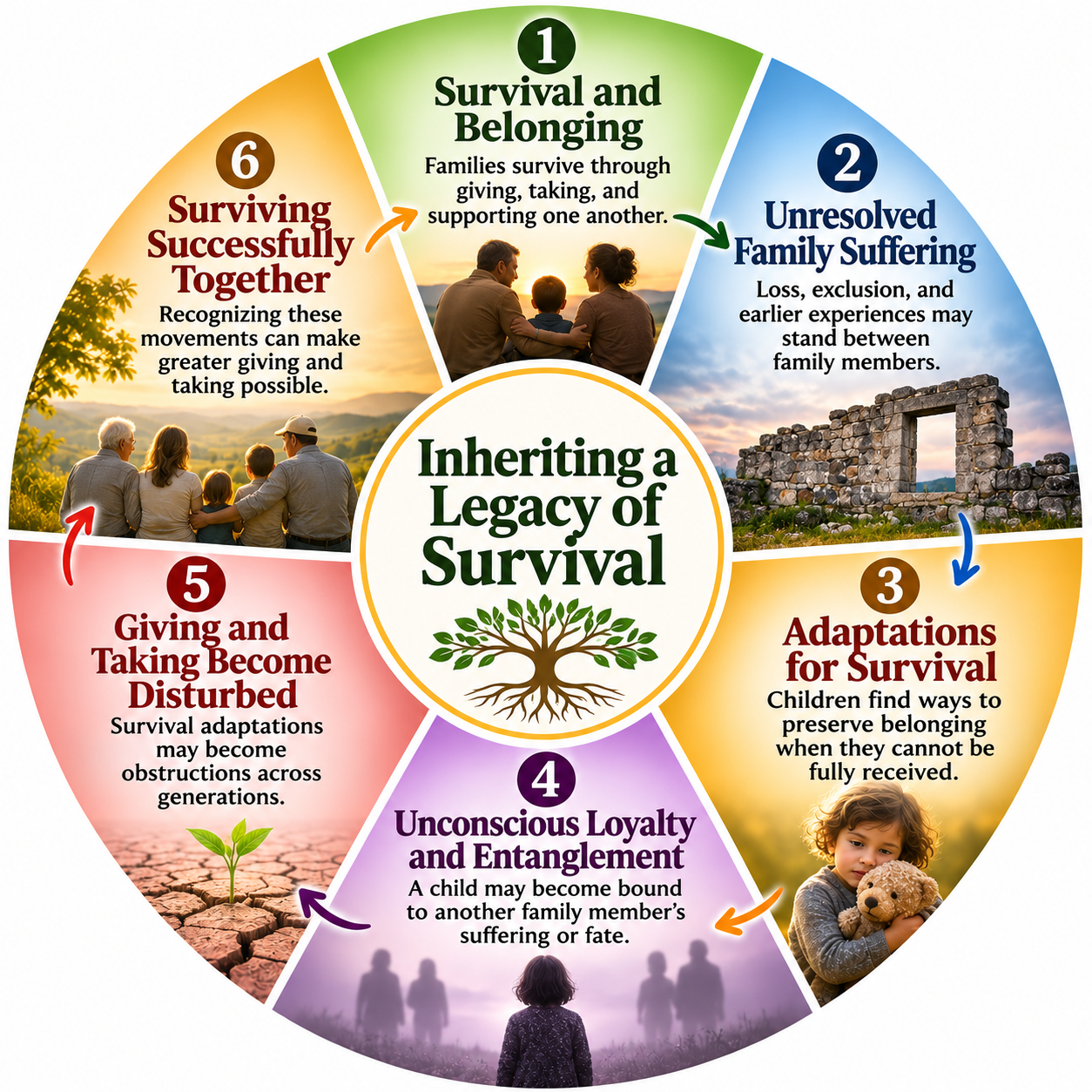
When the Child Becomes a Parent
What helped one generation maintain belonging can become an obstruction for the next. The adaptations we carry into adulthood influence how we relate to our partners, receive our children, and support their relationships with both parents. What once helped us remain close to our own parents can interfere with what becomes available to our children.
Consider a woman who, as a young girl, remained close to her mother by partially turning away from her father. Perhaps her mother suffered in her relationship with him, or something from an earlier generation stood between them. Remaining loyal to her mother helped preserve closeness, but it also restricted what she could take from her father, his family, and his ancestors.
When this woman becomes a mother, the earlier loyalty can influence how she receives her partner as the father of their child. Even when he is willing and available, she can have difficulty supporting her child's movement toward him. Without intending to, she stands between them. Their child senses that turning toward the father threatens closeness with the mother and responds by remaining loyal to her.
Mother and child experience closeness through this shared loyalty, although the child cannot freely turn toward the father and take what is available from him. What once stood between the mother and her father now appears in another form between her child and the child's father. An adaptation that helped the mother remain close to her own mother has become part of what prevents her child from being fully received by both parents.
The same movement can occur when a father remains bound to unresolved suffering or relationships from his family. His earlier loyalties can interfere with how he receives the mother of his children and supports their relationship with her. A son or daughter who remains loyal to the father's suffering or rejection can become restricted in what they take from their mother and her family.
Earlier suffering also influences how parents receive their children directly. When a parent's attention remains directed toward an excluded family member or unresolved loss, less of their attention is available to their baby or young child. Their children then develop adaptations to circumstances shaped by suffering that began before they were born.
Across generations, the original circumstances become increasingly difficult to recognize. Parents believe they are protecting their children, while children experience their adaptations as necessary for remaining close and belonging. What began as one person's response to a difficult family relationship becomes part of the circumstances into which another generation is born.
When Families Become Stuck in Survival
Families become stuck in survival when responses to earlier suffering continue organizing relationships across generations. War, violence, displacement, poverty, illness, and the loss of loved ones can require extraordinary sacrifice, vigilance, and endurance. These responses help people survive difficult circumstances. When they continue influencing family life long after the original danger has passed, survival becomes an inherited pattern.
A family that has endured persecution can continue living with the expectation of danger, even when later generations grow up in safety. Descendants of people who experienced poverty or displacement can remain oriented toward loss and insecurity despite having greater opportunities. Through loyalty to those who suffered, the circumstances of earlier generations continue influencing what feels possible in the present.
The consequences extend beyond individual choices. Parents occupied with earlier suffering have less available for their children. Partners struggle to take support from one another, while descendants remain identified with people whose lives were marked by loss, exclusion, or violence. As these patterns continue, the family's capacity for giving and taking becomes increasingly restricted.
Loyalty to suffering can also make living differently feel like a betrayal. Success becomes difficult when earlier generations endured poverty or failure. Happiness can seem disloyal to someone whose life was marked by grief. Reconciliation becomes difficult when descendants remain identified with victims or perpetrators from an earlier generation. Even the living can remain turned toward the dead, unable to leave their suffering and fate with them.
What began as a response to circumstances that threatened survival becomes part of how later generations experience belonging. Family members continue adapting to dangers, losses, and relationships that belong to the past, while the strength, love, and resources available in the present remain difficult to take. The family continues surviving, but its capacity to live more fully together is restricted.
The difficulty is not survival itself. Survival is fundamental to life, and families have always depended upon one another to meet its challenges. The difficulty arises when the adaptations that once preserved life continue restricting the giving and taking through which family members support one another. What once helped preserve life now restricts the family's ability to draw upon the relationships and resources that sustain it.
Surviving Successfully Together
Surviving successfully together requires more than enduring hardship. It depends upon the giving and taking that sustains life, allowing family members to support one another and draw upon the strength and resources available to them. No individual or family survives entirely through their own efforts.
In families where giving and taking can move more freely, parents draw upon support from their partners, relatives, and others rather than depending upon their children to meet adult needs. Babies and young children can take nourishment, protection, care, and love without becoming responsible for those who provide them. As they grow, what they have taken becomes available for their own relationships and for those who follow them.
This movement also depends upon the relationships among adults. Partners need opportunities to give and take from one another, while grandparents, relatives, and others contribute care, experience, and practical support. The responsibilities of raising children need not rest upon parents alone. Adults who take the support available to them have more to give.
Many families today live without the continuing presence and practical support of a wider family network. Parents carry responsibilities that earlier generations often shared with relatives and others. This places greater demands upon individual relationships and makes the ability to find and take support especially important.
Surviving successfully together does not mean that families are free from suffering, loss, or difficult circumstances. It means that hardship does not have to become the organizing principle of family life. Those who suffered can retain their place and be acknowledged for what they endured, while later generations take the strength and resources available to them and respond to the circumstances of their own lives.
Surviving successfully together depends upon more than what we can give one another in the present. We also draw strength from the lives and relationships of those who came before us.
Receiving From the Wider Family and Ancestors
Our ancestors leave us more than the suffering they endured. Their lives also carry the strength, love, knowledge, and resources that helped our families survive and made our own lives possible. Even when earlier generations experienced extraordinary hardship, their histories contain more than what was lost or remained unresolved.
Every person belongs to two family lineages through their mother and father. Each has its own history, relationships, and resources. What we can take from one parent is not identical to what is available from the other. Both have a place in our lives, even when our experiences of being received by them have been very different.
Loyalty to one parent's suffering can restrict what we take from the other parent and their family. Our belonging to both lineages remains unchanged, even when our ability to experience that belonging and take from what is available becomes restricted.
The wider family offers possibilities beyond the immediate relationship with our parents. Grandparents, siblings, aunts, uncles, and other relatives can receive children in ways that their parents were unable to. These relationships do not replace the parents or change anyone's place within the family. They provide additional opportunities to experience being received and to take from the care, love, and support available within the larger family system.
Our ancestors have a place in our lives beyond the suffering and difficult fates with which we have identified them. They survived, loved, raised children, developed skills, and contributed to the continuation of life. Their presence within the family system offers strength and groundedness that helps us survive and thrive together. An ancestor with whom someone has been entangled can become someone who receives them. Rather than continuing to carry that ancestor's suffering or repeat their fate, the descendant can experience being received and take the strength and support available through that relationship.
When we experience the presence of our ancestors and take more fully from our parents and the wider family, we become more grounded in the family system to which we belong. Their strength, love, and resources support our ability to give and take in our present relationships. We can remain loyal to those who came before us without continuing to carry their suffering, allowing what we have taken to support our own lives and those who follow us.
Recognizing What Stands Between Us
Family Constellations helps us recognize what stands between us and the people from whom we seek love, strength, and support. We look beyond the individual's feelings and behavior to observe the larger family system. An unresolved loss, an excluded family member, or a loyalty to someone who suffered can become visible through the relationships that emerge in a constellation.
As these relationships come into view, we begin to distinguish the people we love from what has stood between us. An infant who experienced a parent's suffering or unavailability as part of the parent could not recognize what lay behind it. As adults, we can begin to see the parent within a larger family history. A mother who struggled to receive her children might herself have been unable to take from her parents. A distant father might have remained turned toward an earlier loss. Understanding these circumstances does not change what happened or excuse harmful actions. Each person's responsibility remains with them.
Recognizing what belongs to someone else can change our relationship to them. A person who has carried a parent's suffering can begin to leave that suffering with the parent without turning away from them. A descendant identified with an excluded ancestor can acknowledge that person's place without continuing to share their fate. Remaining close and experiencing belonging no longer have to depend upon carrying what belongs to another family member.
The distinction between an interrupted reaching out movement and the instinct to be fully received is important. When a young child's movement toward a parent has been interrupted by separation, illness, loss, or another difficult circumstance, completing that movement in a constellation can allow the person to turn toward the parent again. Completing the interrupted movement does not necessarily fulfill the deeper instinct to be fully received. Other relationships, loyalties, or entanglements can still stand between them.
Recognition also opens possibilities for being received beyond the parents. An ancestor previously experienced through suffering or entanglement can become someone whose presence offers strength and groundedness, supporting a fuller participation in giving and taking.
These movements cannot be prescribed in advance. Family Constellations begins with observation of what emerges rather than a predetermined resolution. Sometimes acknowledging someone who was excluded changes what becomes possible. At other times, recognizing a loyalty, allowing the dead to rest, or leaving responsibility with those to whom it belongs provides the movement that is needed. The work follows what becomes visible, respecting each person's place and the circumstances of their family history.
From Survival Adaptations Toward a Fuller Life
We can remain loyal to our families without continuing to carry the suffering of those who came before us. The adaptations that once helped us survive and experience belonging do not have to determine how we live as adults or what we pass to the next generation.
We cannot change what happened to our parents or ancestors, nor can we expect them to give what was unavailable in their lives. We can acknowledge their suffering, respect their fates, and leave with them what belongs to them. Our place within the family does not depend upon repeating their difficulties or living according to their limitations.
What becomes possible is more than freedom from earlier suffering. We can take what our parents were able to give, experience being received by others in our wider family, and draw upon the strength and groundedness available through our ancestors. Their presence supports our capacity to participate in life rather than remain occupied with what earlier generations endured.
As we take more fully, we have more to give. Parents become more available to their children, adults participate more fully in their relationships, and what has been received becomes available to those who follow. The instinctive movement toward being received finds new possibilities for fulfillment within the larger family system.
Families will always face hardship, loss, and circumstances that require cooperation and endurance. Surviving successfully together does not mean leaving these realities behind. It means drawing upon the strength, love, and resources of our families to meet life's challenges without remaining bound to the suffering of earlier generations.
We inherit more than the struggle to survive. We also inherit the strength and resources that make it possible to live more fully and thrive together.
About the Author
Barry Krost has been studying Family Constellations since 2003 and has over 40 years of experience in bodywork, somatic education, and systemic healing. He teaches Family Constellations internationally, mentors facilitators through his Training & Certification Program, and has presented at international systemic constellations conferences.
His Resource Library draws on decades of professional experience and ongoing study, offering clear, thoughtful, and grounded education for individuals and professionals seeking to better understand Family Constellations.
Explore Further
You may also be interested in:
Would you like to explore what may be standing in the way of receiving and being received within your family system?
Learn about Private Family Constellation Sessions Online or join an Online Group Session.
Frequently Asked Questions
What does it mean for a family to be stuck in survival?
A family becomes stuck in survival when adaptations to earlier suffering continue shaping relationships across generations. Responses that once helped people endure danger or loss can restrict the giving and taking that supports family life, even after circumstances have changed.
How can unconscious loyalty become an adaptation for survival?
Babies depend upon their parents and others for survival and care. When suffering or unresolved relationships stand between parent and child, a young child can adapt by sharing what the parent carries. That loyalty preserves a sense of closeness without necessarily fulfilling the deeper instinct to be fully received.
How do unconscious loyalty and entanglement disrupt giving and taking?
Parents give, and children take what is available. When children attempt to relieve a parent's suffering or assume adult responsibilities, they begin giving where they need to take. This reversal restricts what becomes available to them and what they can later carry into their own relationships.
Can a parent's childhood adaptation affect their own children?
Yes. A woman who stayed close to her mother by turning away from her father can carry that adaptation into parenting. It can influence how she relates to her partner and supports her children's relationship with their father. What once preserved closeness becomes part of the circumstances the next generation must navigate.
What is the difference between being stuck in survival and surviving successfully together?
Being stuck in survival means that responses to earlier hardship continue organizing family relationships. Surviving successfully together means drawing upon the giving and taking that supports life: adults supporting one another, children taking what is available, and families meeting present challenges without remaining governed by earlier suffering.
How can Family Constellations help us understand these inherited patterns?
Family Constellations brings relationships in the wider family system into view, including exclusions, losses, and loyalties that have remained difficult to recognize. This work helps distinguish the people we love from what stands between us, while respecting each person's place and responsibility. It can also open possibilities for experiencing being received by the wider family and ancestors.
