
A child’s natural reaching toward a parent can stop when separation, loss, or unavailability prevents them from feeling received. The longing may remain while reaching becomes painful or frightening. Family Constellations considers where this movement was interrupted, how withdrawal and loyalty developed, and how the unfinished reaching continues through difficulties with closeness, trust, and receiving support.
Introduction
One of our deepest human needs is for connection, safety, and belonging.
In Family Constellations, interrupted reaching out movement describes what happens when a child's natural movement toward a parent or caregiver is disrupted before they feel fully received or secure.
This interruption may occur through physical separation, emotional unavailability, trauma, or overwhelming family circumstances. Even many years later, it may contribute to difficulties with trust, closeness, receiving support, or a persistent sense of disconnection.
Family Constellations explores how trauma, unconscious loyalty, entanglement, and unresolved family dynamics may continue shaping these patterns across generations.
The Natural Movement Toward Connection
Babies instinctively reach toward their parents for safety, love, nourishment, protection, and belonging. The movement is toward being received, not simply toward being physically near the parent.
When the reaching is interrupted, the child’s need for connection remains. The child may stop reaching outward while the longing continues. This unfinished movement is the central subject of the article.
The Natural Order of Giving and Taking
In a healthy parent-child relationship, parents give and children receive. Life is passed from one generation to the next through this natural movement.
Between parent and child:
Parents give
Children receive
This movement naturally flows in one direction. In adult relationships, giving and receiving become more reciprocal. When children cannot fully receive from their parents emotionally or relationally, their movement toward life and relationship may become interrupted.
The visual map below illustrates the impact of interrupted movement on the child, their adult relationships and generations that follow.
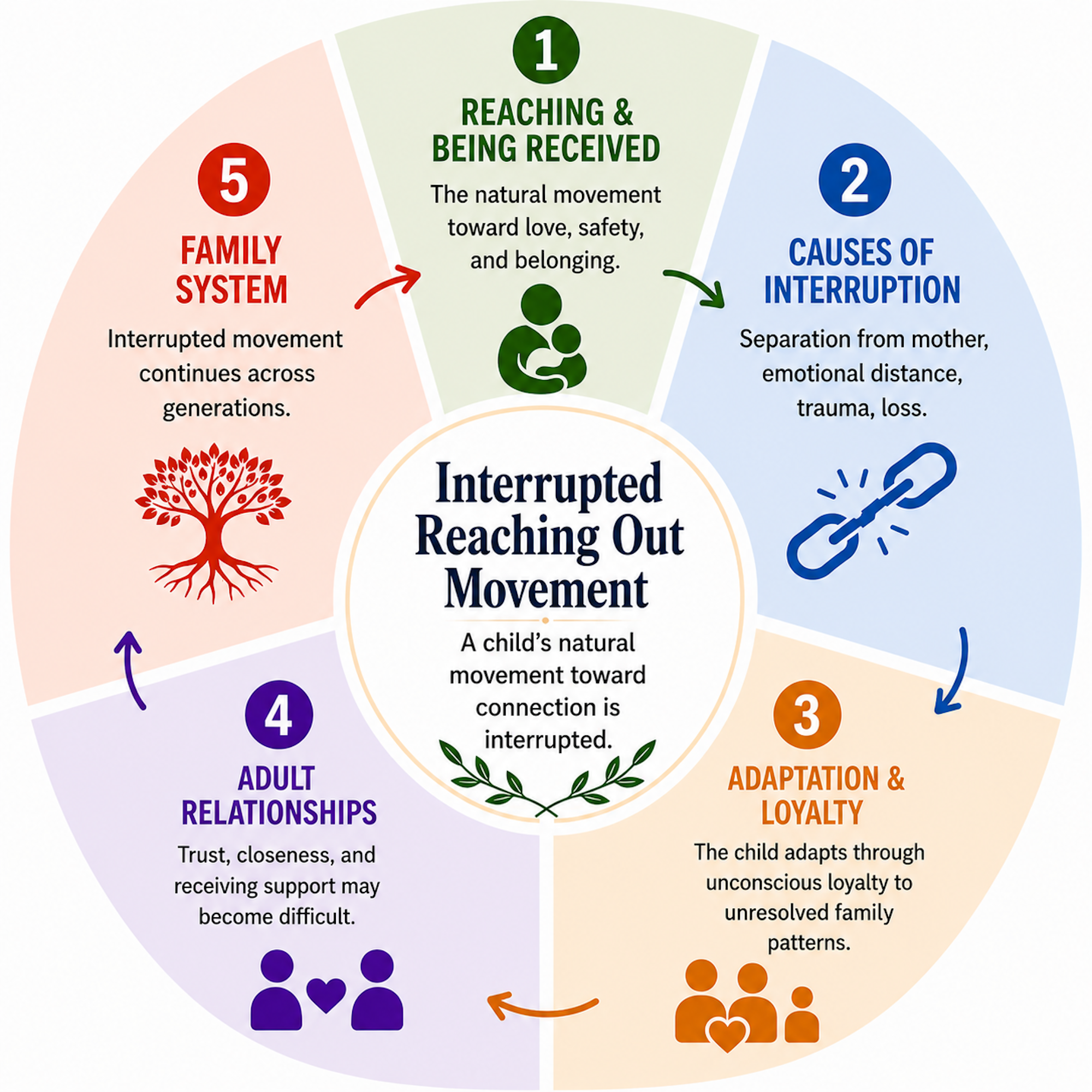
When the Movement Is Interrupted
Sometimes this natural movement is interrupted before the child feels safe, received, or emotionally connected.
This may happen through:
Illness or hospitalization
Separation from a parent
Emotional unavailability
Trauma or shock
Neglect
Death or loss
Conflict between parents
Overwhelming stress within the family
Generational or inherited trauma
The child may experience longing, fear, despair, anger, withdrawal, or resignation. Even when children appear to adapt, the longing for closeness often remains unfinished.
The Interruption and Its Circumstances
Adoption, migration, violence, or family loss can include circumstances that interrupt reaching toward a parent. They also involve other relationships and losses. Separation from a homeland, for example, is not the same relationship as a child’s unfinished reaching toward a mother or father.
The work identifies the particular interruption: toward whom the child was reaching, what happened, and where that movement stopped. The event and the unfinished relationship need to be distinguished.
The interruption can also be experienced bodily. A person may tense, draw back, or find it difficult to move toward closeness even while wanting connection. These experiences are explored in relation to the reaching and withdrawal; they do not by themselves establish what happened or who is involved.
Reaching and Withdrawing
Interrupted reaching-out movement often creates an inner conflict: longing for closeness while fearing it at the same time.
Some people repeatedly pursue closeness only to withdraw again. Others push people away, shut down emotionally, fear dependency, struggle to trust relationships, or experience repeated disappointment in relationships.
Many continue seeking connection while simultaneously protecting themselves from rejection or emotional pain.
Loyalty and Interrupted Movement
When reaching toward a parent is not received, a child may find another way to remain connected through loyalty to the parent’s suffering. Receiving care, enjoying life, or becoming independent can then feel like leaving the parent behind. The inner movement may be, “If I fully receive, I leave you alone,” or “I will stay with you in your suffering.”
The unfinished reaching and the loyalty need to be distinguished. One concerns the child’s longing to be received; the other concerns remaining connected by carrying or sharing what belongs to someone else. Both can influence closeness, trust, receiving support, and movement toward life.
Earlier Interruptions Within the Family
A parent may carry an interrupted connection from their own childhood or remain entangled with an earlier loss, exclusion, war, persecution, or displacement. Their attention may remain with someone who was lost or with circumstances they could not fully face. This can stand between the parent and receiving their child.
A constellation can bring these earlier relationships into view while keeping attention on what the child experienced. Recognizing the parent’s history does not remove the child’s unmet longing or mean that the child must resolve what the parent carries.
Connection With Both Parents
The child receives life through both parents. Reaching toward the mother concerns receiving care, nourishment, and closeness; connection with the father supports movement beyond the protected sphere of childhood and toward the wider world.
When connection with either parent is interrupted, the work turns toward the particular relationship: what happened, what remains longed for, and what stands between the child and receiving from that parent. Each parent retains their place, including when what they could give was limited.
Movement Toward Healing with Family Constellations
A Family Constellation can be set up to revisit the child’s reaching toward a parent and the experience of not being received. The work acknowledges what happened, what prevented the parent from receiving the child, what the child did not receive, and the consequences of that interruption.
The movement is not necessarily toward renewed contact with the parent. The parent can be allowed their place, and the person can recognize that life came through them while remaining truthful about what was missing. As the unresolved reaching finds a place, support from other family members, ancestors, partners, mentors, teachers, and community may become easier to perceive and receive.
Possible Healing Sentences
“I take you now as my mother/father.”
“I come now.”
“Please receive me when I reach out to connect.”
“I take life fully now.”
About the Author
Barry Krost has been studying Family Constellations since 2003 and has over 40 years of experience in bodywork, somatic education, and systemic healing. He teaches Family Constellations internationally, mentors facilitators through his Training & Certification Program, and has presented at international systemic constellations conferences. His Resource Library reflects decades of professional experience and ongoing study, offering clear, thoughtful, and grounded education to help individuals and professionals better understand Family Constellations.
Explore Further
You may also be interested in:
Ready to explore how these dynamics may be affecting your own life?
Schedule a Complimentary Consultation to discuss whether Family Constellations may be right for you.
Frequently Asked Questions
What is interrupted reaching out movement?
It refers to an interruption in a child’s natural movement toward connection, safety, and emotional closeness with a parent or caregiver.
What causes interrupted reaching out movement?
It may result from separation, trauma, emotional unavailability, hospitalization, loss, abuse, conflict, or overwhelming stress within the family system.
Can interrupted movement affect adult relationships?
Yes. It may contribute to fear of closeness, emotional withdrawal, difficulty trusting, over-pursuit of connection, or instability in relationships.
Can interrupted movement happen across generations?
Yes. Family Constellations explores how unresolved trauma and emotional interruptions within the family system may continue affecting later generations.
Can Family Constellations help with interrupted movement?
It may help reveal unconscious loyalties, relational patterns, and unresolved emotional movements while supporting greater connection and balance.
