
The Lasting Impact of Abandonment
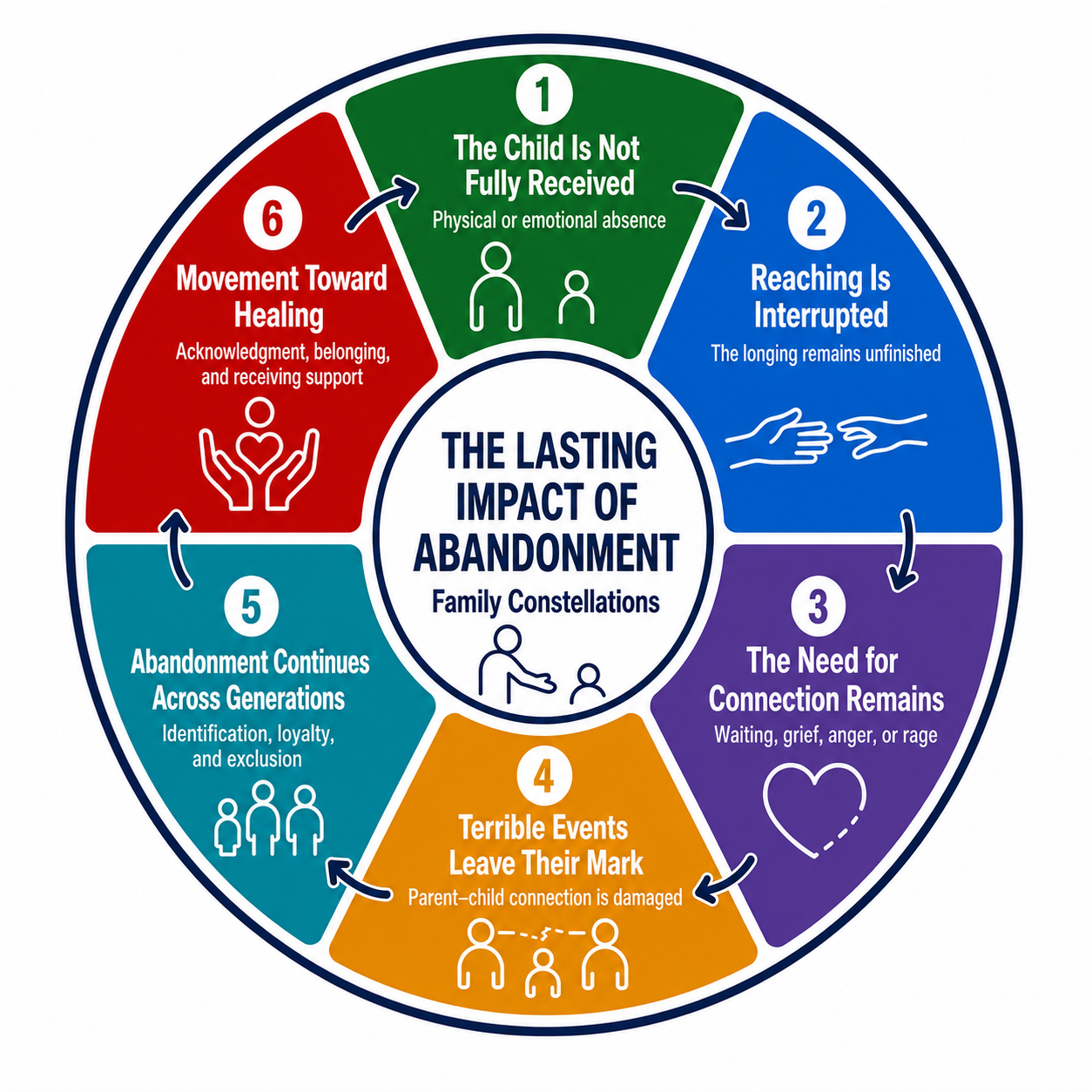
A parent’s absence or inability to receive a child can leave longing that continues through waiting, grief, anger, or rage. The need for connection remains even when the child stops reaching. Family Constellations considers what the child did not receive, the family history affecting the parent, and why care available in adult life can remain difficult to recognize or accept.
Introduction
An abandonment wound develops when a child experiences the loss, absence, or unavailability of a parent. It also develops when a parent remains physically present but is unable to fully receive the child. The child does not experience being safe, seen, loved and nourished. The absence of these experiences is felt as terror, emptiness, rage and despair.
The instinct to reach for our parents, particularly our mother at birth, does not go away. When that reaching is not received, it becomes a constant feeling of unresolved need and absence, forming a deep foundation for the abandonment wound.
Family Constellations offers one way of understanding this wound. It looks not only at what the child experienced, but also at the family events and generational sources that affected a parent’s ability to receive their child, stay with their partner, or remain connected to the family.
Abandonment Is More Than Physical Absence
Abandonment occurs through the death, departure, disappearance, or prolonged absence of a parent. It may also be connected with divorce, adoption, migration, displacement, war, illness, imprisonment, or institutionalization.
Physical presence alone does not ensure that a child is received. A parent may remain in the home while being unable to turn toward the child, protect them, or take up the parental role. For the child, the essential experience is not simply whether the parent was there, but whether the child experienced being safe, seen, loved and nourished.
When these experiences are missing, the child’s reaching remains unfinished. Family Constellations describes this as an interrupted reaching-out movement: the natural movement toward the parent begins but cannot be completed. The longing remains even when the child learns to stop showing it.
The Need for Connection Remains
Children need to be connected to their parents. The parent’s absence does not end this need or the longing for connection. Instead, the child may remain connected through waiting, grief, anger, rejection, or rage.
Rage may be the only way to stay connected to the absent parent. Although rage appears to push the parent away, it can preserve the relationship by keeping the parent constantly present within the child. The intensity of the feeling reveals the strength of the unresolved need for connection.
This also helps explain why acknowledging the absent parent can be so difficult. Terror, emptiness, rage and despair may prevent us from recognizing that the parent still belongs. Rejecting the parent can feel necessary for survival, even while the need for connection remains beneath the rejection.
How Terrible Events Enter the Living Family Story
Terrible events—including war, persecution, displacement, early death, violence, imprisonment, and catastrophic loss—leave their mark on the living family story, primarily by damaging the connection between children and their parents across multiple generations. They make giving and receiving challenging and disrupt the natural roles of parents in serving one another and their children, including the biological role of men to protect the family.
A parent who was orphaned, abandoned, displaced, traumatized, or excluded may have survived by turning away from unbearable loss or escaping the circumstances surrounding it. Later, that parent may struggle to receive their own child or remain connected to a partner and family, thus beginning a generational pattern of disconnection between parents and children.
Family Constellations can help locate these generational sources. The work asks:
What happened in the family?
Who was lost, abandoned, or excluded?
Which terrible events damaged the connection between parents and children?
Where was a movement toward connection interrupted?
What affected a parent’s ability to receive their child, stay with their partner, or remain connected to the family?
Locating these sources does not erase the child’s experience. It places that experience within the family history that helped shape it.
Abandonment Across Generations
The effects of abandonment may continue through identification and unconscious loyalty. A child may identify with a parent or ancestor who was abandoned and unknowingly carry the same longing, absence, or exclusion. Through unconscious loyalty, a later family member may remain connected to someone whose abandonment and suffering were never recognized. These identifications and loyalties are more likely to develop in children who were not received by their parents.
The absent parent may also become excluded from the family story—rejected, forgotten, spoken about with contempt, or left entirely unspoken. Yet exclusion does not end belonging. From a Family Constellations perspective, every parent continues to have a place in the family system.
The Difficulty of Being Received Later
As a child, it can be difficult to find someone other than our parents who can fully receive us. The original reaching remains directed toward the parents, even when they are unavailable. Later in life, the pain of abandonment can make it challenging to be in a position to be received, to perceive what is being offered, or to take it in.
Care, protection, recognition, and love may be available, yet the unresolved need continues to look toward the person who could not provide them. What is offered by others can feel insufficient, unfamiliar, or impossible to recognize because it does not come from the parent toward whom the child still reaches.
Healing the abandonment wound may require the experience of being received by someone other than our parents later in life. These sources can include grandparents, other family members, mentors, teachers and the ancient ancestors. They do not replace the parents. They provide an experience of being received that makes it possible to take in something that was missing.
Movement Toward Healing with Family Constellations
From a Family Constellations perspective, movement toward healing begins with acknowledging the abandonment and its consequences, recognizing what the child did not receive, and allowing the absent parent to have a place within the family system. A constellation can revisit the interrupted reaching-out movement while distinguishing the child’s experience from the parent’s history, limitations, and fate.
Receiving life through our parents does not mean that we received everything we needed from them. It means recognizing that life came through them while remaining truthful about the abandonment and its consequences.
The movement is not toward forgetting the abandonment or minimizing what was missing. It is toward no longer waiting for the absent parent to provide what they could not give. As support from other family members, ancestors, mentors, teachers, partners, and community becomes easier to perceive and receive, the unresolved reaching can begin to find a place of rest, and the person can turn more fully toward adult life and relationships.
About the Author
Barry Krost has been studying Family Constellations since 2003 and has over 40 years of experience in bodywork, somatic education, and systemic healing. He teaches Family Constellations internationally, mentors facilitators through his Training & Certification Program, and has presented at international systemic constellations conferences.
His Resource Library draws on decades of professional experience and ongoing study, offering clear, thoughtful, and grounded education for individuals and professionals seeking to better understand Family Constellations.
Explore Further
You may also be interested in:
Ready to explore how these dynamics may be affecting your own life?
Learn about Private Family Constellation Sessions Online or join an Online Group Session.
Frequently Asked Questions
What is an abandonment wound?
An abandonment wound develops when a child experiences the loss, absence, or unavailability of a parent. It also develops when a parent remains physically present but is unable to fully receive the child.
Can a child experience abandonment when a parent is physically present?
Yes. Physical presence alone does not ensure that a child is received. A parent may remain in the home while being unable to turn toward the child, protect them, or take up the parental role.
Why does the longing for an absent parent continue?
The instinct to reach for our parents, particularly our mother at birth, does not go away. When that reaching is not received, it becomes a constant feeling of unresolved need and absence.
Why can rage remain connected to abandonment?
Rage may be the only way to stay connected to the absent parent. Although rage appears to push the parent away, it can preserve the relationship by keeping the parent constantly present within the child.
Can abandonment continue across generations?
Yes. A child may identify with a parent or ancestor who was abandoned and unknowingly carry the same longing, absence, or exclusion. Through unconscious loyalty, a later family member may remain connected to someone whose abandonment and suffering were never recognized.
How does Family Constellations explore abandonment?
Family Constellations can help locate the generational sources that affected a parent’s ability to receive their child, stay with their partner, or remain connected to the family. It also explores interrupted reaching, exclusion, belonging, identification, and unconscious loyalty.
Does acknowledging the absent parent excuse what happened?
No. Allowing the absent parent to have a place in the family system does not change what happened or what the child did not receive. It remains truthful about the abandonment and its consequences.
Can support from someone other than a parent help with an abandonment wound?
Healing the abandonment wound may require the experience of being received by someone other than our parents later in life. These sources can include grandparents, other family members, mentors, teachers, and the ancient ancestors.
Why can it be difficult to receive love or support later in life?
The unresolved need continues to look toward the person who could not provide what was needed. What is offered by others can feel insufficient, unfamiliar, or impossible to recognize because it does not come from the parent toward whom the child still reaches.
