
Unconscious Loyalty, Identification, and Family Dynamics
Introduction
Many people encounter repeating relationship or family patterns that seem difficult to explain. They may experience persistent guilt or shame, over-responsibility, difficulty moving forward in life, or a sense that they are carrying something that does not arise from their own experience. These patterns may raise the question of whether something from the family history continues to influence the present.
Family Constellations offers another perspective by exploring whether these experiences are connected to entanglements within the family system.
An entanglement occurs when someone unconsciously identifies with another family member or carries, represents, follows, or repeats something belonging to that person. This may include the person’s suffering, burden, responsibility, or fate. Entanglements can continue influencing family relationships and repeating patterns across generations.
Unconscious Loyalty and Entanglement
Every person belongs to their family system. Out of love and loyalty, children may unconsciously identify with family members who experienced suffering, exclusion, trauma, or loss.
A person may remain bound to a parent’s suffering, unresolved grief, an excluded family member, a traumatic family experience, or a difficult family fate. These loyalties operate outside conscious awareness and can continue influencing relationships and repeating patterns.
Some people describe an inner movement that feels like:
“I will carry this for you.”
“I should not have more than you.”
“If you suffered, I should suffer too.”
“I cannot leave you behind.”
These movements arise through love and loyalty rather than conscious choice. They can bind a later family member to suffering, a burden, or a fate that belongs to another person or an earlier generation.
Understanding Entanglements
This short video explores how unconscious loyalty, belonging, and identification with earlier family members may contribute to entanglements within the family system. It explains how significant family experiences may continue across generations through unconscious loyalty, identification, carrying burdens, and repeating patterns.
How Entanglements May Be Experienced
An entanglement can feel deeply personal and convincing because the person experiences the burden or repeating movement as their own.
A person may experience persistent guilt or shame, anxiety or fear, over-responsibility, exhaustion, difficulty moving beyond a family member’s suffering, or a sense of carrying something that does not fully belong to them. These experiences may seem larger than the person’s own life or difficult to explain through their personal history alone.
During a Family Constellation, entanglements may become more visible through representatives, movements within the constellation, or recurring relationship patterns. Some facilitators describe this process as working with the Knowing Field, where hidden loyalties and unconscious identifications can emerge into awareness.
Common Sources of Entanglement
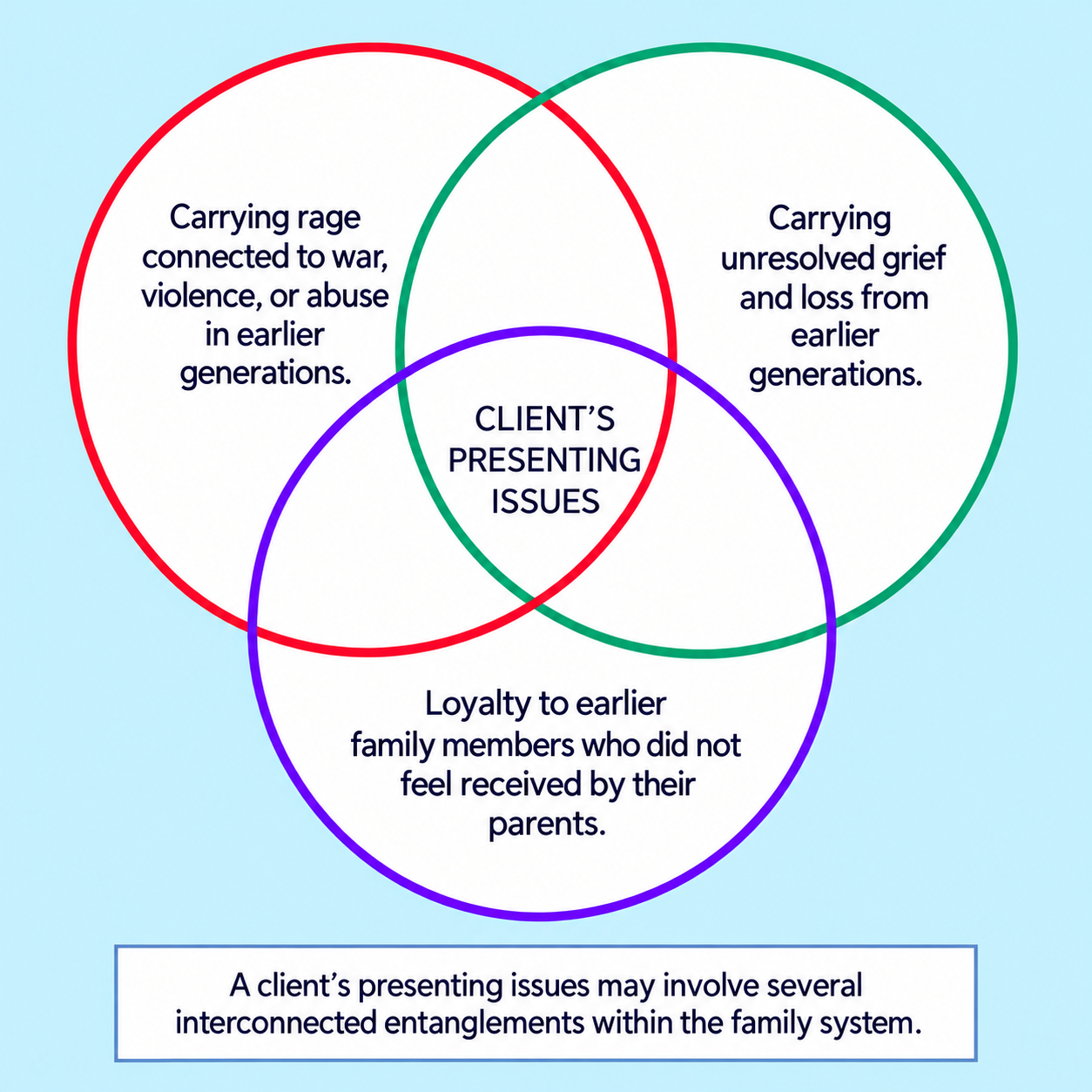
Family Constellations explores how entanglements may develop in connection with family experiences such as trauma or abuse, war or violence, early death, suicide, addiction, abandonment, grief, exclusion, family secrets, shame, or concealment.
When a person, loss, event, or fate remains excluded, concealed, or unacknowledged, a later family member may become identified with that person, their suffering, or their fate.
The following illustration shows how several systemic dynamics may overlap in a client’s presenting issues.
Difficulty Distinguishing the Past from the Present
A person who is entangled may have difficulty distinguishing between their own life and what they are carrying for another family member. They may experience a burden, responsibility, suffering, or repeating movement as their own even when it is connected to someone who came before.
The systemic question is what belongs to whom. A constellation may reveal that a burden, responsibility, or fate belongs to an earlier family member and that the later person has been carrying or repeating it through love and loyalty. This does not reflect personal weakness or lack of effort.
Some people feel guilty having more or becoming more successful than earlier family members. Others remain loyal through sacrifice or limitation without fully understanding the connection.
Entanglements in Relationships
Entanglements can become visible in adult relationships. A person may be drawn to a partner who cannot fully turn toward or receive them, repeat an earlier pattern of abandonment, assume responsibility that belongs to the partner, or remain in a relationship that repeats something from the family history.
In these relationships, one partner may represent an excluded or absent family member, or the relationship may carry a loyalty connected to an earlier relationship or family fate. Until this connection is recognized, something from the family system may continue to be repeated through the present relationship.
Movement Toward Healing with Family Constellations
Movement toward healing begins with recognizing the person, relationship, loss, or fate with which someone has become entangled. A constellation can make visible the love and unconscious loyalty through which a later family member carries, follows, represents, or repeats something belonging to someone who came before.
When the earlier person and what happened are acknowledged, their burden, responsibility, and fate can remain with them. The later family member can recognize, “You are you, and I am I,” without rejecting the connection or excluding the earlier person from the family.
The movement is not away from belonging. It is toward remaining connected without carrying, suffering, or repeating what belongs to another person or generation, while turning more fully toward one’s own life.
About the Author
Barry Krost has been studying Family Constellations since 2003 and has over 40 years of experience in bodywork, somatic education, and systemic healing. He teaches Family Constellations internationally, mentors facilitators through his Training & Certification Program, and has presented at international systemic constellations conferences. His Resource Library reflects decades of professional experience and ongoing study, offering clear, thoughtful, and grounded education to help individuals and professionals better understand Family Constellations.
Explore Further
You may be interested in:
Ready to explore how these dynamics may be affecting your own life?
Learn about Private Family Constellation Sessions Online, join an Online Group Session, or Schedule a Complimentary Consultation to discuss the next step that may be right for you.
Frequently Asked Questions
What is an entanglement in Family Constellations?
An entanglement occurs when someone unconsciously identifies with another family member or carries, represents, follows, or repeats something belonging to that person. This may include the person’s suffering, burden, responsibility, or fate.
What causes entanglements?
Family Constellations explores how entanglements may develop when a person, loss, event, or fate remains excluded, concealed, or unacknowledged within the family system. A later family member may then identify with that person or carry something belonging to them.
How do entanglements affect relationships?
Entanglements may become visible through repeating patterns of abandonment, assuming responsibility that belongs to a partner, or being drawn to someone who cannot fully turn toward or receive the person. A partner may also represent an excluded or absent family member or someone connected to an earlier relationship or family fate.
Are people aware of an entanglement?
Not necessarily. A person may experience a burden, loyalty, or repeating movement as their own without recognizing its connection to another family member or an earlier family event or fate.
Can Family Constellations help reveal entanglements?
Family Constellations provides a way of exploring unconscious loyalties, identifications, and hidden family dynamics. Representatives, movements within the constellation, or repeating relationship patterns may help make visible whom the person is identified with and what they may be carrying or repeating for another family member. This recognition can clarify what belongs to whom.
