
Anxiety may become more understandable when considered within a person’s family relationships and history. Family Constellations attends to interrupted connection, fear connected to earlier family experiences, and unconscious loyalties through which someone may carry another person’s fear or responsibility. These relationships can give context to anxiety that feels difficult to explain through present circumstances alone.
Introduction
Anxiety can feel exhausting, overwhelming, and difficult to explain. Many people describe living with a constant sense of unease, finding it hard to relax, experiencing fear without a clear reason, feeling emotionally overwhelmed, struggling with racing thoughts, carrying chronic physical tension, or experiencing panic and dread. For some, anxiety also makes it difficult to feel safe, grounded, or fully present in everyday life.
For some people, anxiety remains active in the background of life, even during calm or positive experiences. Anxiety is complex. Biological, psychological, social, environmental, and medical factors may all contribute to its development.
Family Constellations does not view anxiety as being caused by family dynamics, nor does it replace therapy, medical care, or psychological treatment. It offers a systemic perspective on how interrupted connection, trauma, belonging, unconscious loyalty, and family history may influence a person's experience of anxiety.
Rather than asking only, "What is wrong with me?" Family Constellations also invites another question:
"What larger family story might help make sense of this experience?"
A Systemic View of Anxiety
The systemic question is whether fear belongs to a danger in the present, an experience from the person’s own life, or a relationship with someone in the family who endured danger or loss.
Questions that may arise include:
Who in the family experienced overwhelming fear or terror?
Was there exclusion, abandonment, violence, or sudden loss?
Is someone in the family system forgotten or emotionally cut off?
Could the anxiety reflect unconscious identification with someone from an earlier generation?
These questions are not intended to create blame or simple explanations. They simply broaden the exploration of possible systemic influences.
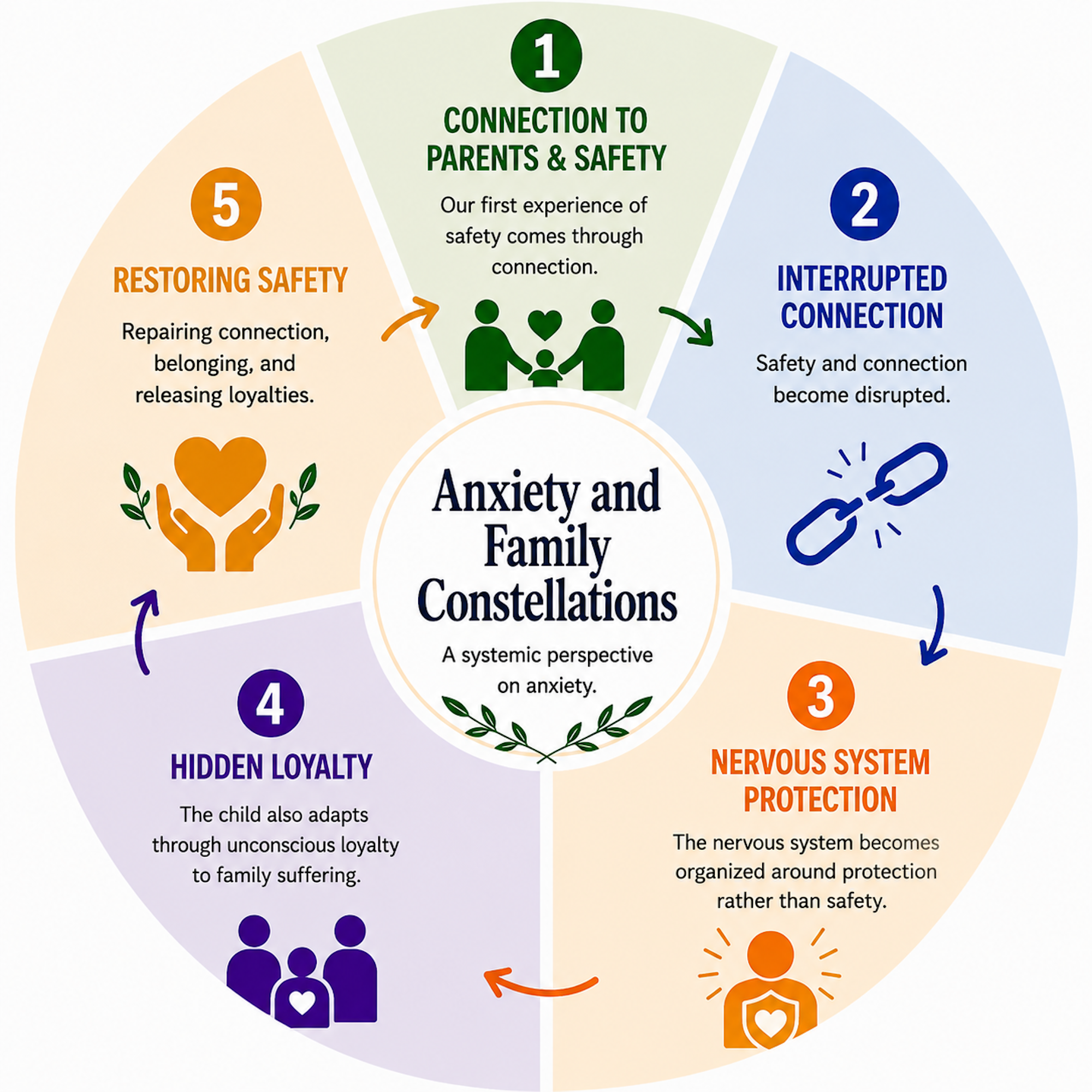
Below is a visual representation of how Family Constellations looks at anxiety and possible healing for it.
Anxiety and Survival
When childhood involves fear, conflict, instability, or overwhelming events, remaining alert can become necessary. A child may watch a parent’s mood, listen for signs of conflict, hide their needs, or prepare to intervene. This watchfulness may have helped the child navigate circumstances in which safety could not be taken for granted.
The vigilance can continue into adulthood even when the original danger is no longer present. A person may find it difficult to relax, trust support, or stop anticipating that something will go wrong. A caring relationship or a stable home may be available while the person continues responding as though protection depends entirely on remaining alert.
Family Constellations considers both what happened and whether the child could reach toward a parent for protection and comfort. A parent may have been frightened, overwhelmed, unavailable, or involved in the danger. A constellation can bring that relationship into view, acknowledging the circumstances in which vigilance became necessary and distinguishing them from the person’s present life.
Anxiety and Emotional Disconnection
Fear can make closeness feel unsafe even when connection is wanted. A person may become disconnected from their feelings, relationships, or sense of safety. Trust may become difficult, and life can begin to feel more like something to endure than something to fully engage with.
These experiences may be accompanied by patterns such as:
Overthinking
People-pleasing
Perfectionism
Hyper-independence
Emotional withdrawal
Emotional numbing
These responses may develop during overwhelming family experiences as ways of preserving safety, connection, or belonging. A person may try to maintain relationships by pleasing others, avoiding conflict, taking responsibility for everything, or keeping their distance.
Family Constellations considers what these patterns may remain connected to within the family system: an earlier danger, an interrupted relationship with a parent, or unconscious loyalty to someone whose suffering or fate continues to influence later generations. This raises the possibility that some patterns may be connected not only to a person's own experiences but also to significant events in their family history.
Generational Trauma and Anxiety
Family Constellations explores how unresolved trauma may continue influencing later generations. Experiences such as war, abuse, addiction, persecution, suicide, abandonment, migration, early death, and family secrets may leave lasting effects within a family system. Even when these experiences are not openly discussed, their consequences may continue to shape family relationships, recurring patterns, and a sense of safety across generations.
Later generations may become connected to earlier family experiences through unconscious loyalty or identification with someone who suffered. A person may experience anxiety, chronic fear, hypervigilance, or difficulty feeling safe without understanding how these experiences relate to their family history. Some people describe carrying a fear that feels larger or older than their own experience.
War, persecution, violence, abandonment, and sudden death can leave fear connected to particular people and events within the family. A descendant may identify with someone who lived through danger, even without knowing the full history. A constellation explores whom or what the fear may be connected to, while recognizing that the feeling alone does not establish an ancestral connection.
Although unresolved family experiences may influence later generations, a person's earliest experiences of safety also develop through relationships with their parents. Understanding anxiety within the family system therefore includes both direct childhood experiences and possible connections to earlier generations.
Anxiety and Connection to Parents
In Family Constellations, connection with parents is often considered foundational to emotional safety and belonging. When reaching toward a mother or father was interrupted, the longing for connection and support may continue alongside fear of rejection, abandonment, or closeness.
This interrupted connection may be experienced through:
Insecurity
Chronic inner tension
Fear of abandonment
Difficulty receiving support
Fear of closeness
Difficulty feeling grounded or safe in relationships
A constellation considers the particular interruption in the parent–child relationship, including what prevented the parent from being available to receive the child's reaching. It also explores whether unconscious loyalty to a parent or another family member may contribute to the continuing experience of anxiety.
Recognizing the earlier interruption helps distinguish fear connected to the parent–child relationship from danger in the person's present circumstances. It also brings attention to the continuing longing for connection and support that may remain beneath the anxiety.
Hidden Loyalties and Anxiety
Sometimes anxiety may reflect an unconscious loyalty to someone in the family who experienced suffering, danger, fear, or profound loss. This can appear as carrying fear that does not fully belong to the present, feeling guilty about happiness or success, remaining emotionally connected to family suffering, fearing movement forward in life, or having difficulty experiencing safety, freedom, or well-being. From a Family Constellations perspective, these patterns may represent an unconscious attempt to remain connected to those who came before, even when that connection comes at a personal cost.
A person may unconsciously feel:
"If I relax, something bad will happen."
"I should not have more than others."
"I stay connected through suffering."
"If others suffered, I should suffer too."
These movements are not conscious decisions. From a Family Constellations perspective, they may represent attempts to preserve love, belonging, and connection within the family system.
Anxiety and Belonging
One of the central principles of Family Constellations is that everyone has a deep need to belong. Sometimes anxiety may develop around fears of losing connection, disappointing others, being excluded, or separating from important family relationships.
Family Constellations explores whether people may unconsciously carry burdens or remain connected to the suffering of family members through loyalty. A person may fear that moving toward a different life, finding happiness, or leaving behind familiar struggles means separating from someone they love. Even relaxing or experiencing greater freedom may feel like abandoning a suffering family member.
From this perspective, anxiety may reflect a conflict between the desire to move forward in one's own life and the unconscious need to preserve belonging within the family system. What appears to be fear of change may also involve loyalty to someone whose suffering or fate continues to hold an important place in the family.
The systemic question is whether a person can remain connected to their family without continuing to carry fear or suffering as an expression of loyalty. Belonging does not require repeating another family member's difficulties or limiting one's own life in order to remain close.
Movement Toward Healing with Family Constellations
From a Family Constellations perspective, movement toward healing begins with recognizing how anxiety may be connected to fear, trauma, interrupted connection, or unconscious loyalty within the family system. A constellation can make visible what happened, whose fear or burden may be carried, where connection was interrupted, and how the need to belong remains connected to the anxiety.
As these dynamics are seen, burdens that belong to earlier family members can remain with them, those who were excluded can be given their place, and interrupted reaching can be acknowledged. The movement is toward receiving support, remaining connected without carrying another person’s suffering, and turning more fully toward one’s own life.
About the Author
Barry Krost has been studying Family Constellations since 2003 and has over 40 years of experience in bodywork, somatic education, and systemic healing. He teaches Family Constellations internationally, mentors facilitators through his Training & Certification Program, and has presented at international systemic constellations conferences. His Resource Library reflects decades of professional experience and ongoing study, offering clear, thoughtful, and grounded education to help individuals and professionals better understand Family Constellations.
Explore Further
You may also be interested in:
Ready to explore how these dynamics may be affecting your own life?
Learn about Private Family Constellation Sessions Online or join an Online Group Session.
Frequently Asked Questions
Can Family Constellations help with anxiety?
Family Constellations may help individuals explore hidden family dynamics, unresolved trauma, interrupted connections, and generational patterns that could contribute to anxiety and emotional distress.
Is anxiety always connected to family trauma?
No. Anxiety can have many causes, including biological, psychological, environmental, medical, and situational factors. Family Constellations simply offers an additional systemic perspective.
Can unresolved family experiences contribute to anxiety?
Family Constellations suggests that unresolved trauma, grief, exclusion, fear, and emotional burdens within the family system may continue influencing later generations.
Why do I feel anxious even when life seems relatively safe?
Fear may remain connected to earlier danger or an interrupted relationship with a parent. A constellation can also explore whether loyalty to someone who endured danger has become relevant. Its focus is distinguishing the present situation from the earlier person or experience that comes into view.
What is generational trauma?
Generational trauma refers to unresolved emotional pain, stress, or trauma that may continue affecting later generations within a family system.
Can Family Constellations replace therapy or medical care?
No. Family Constellations is not a replacement for medical, psychiatric, psychological, or trauma treatment. It is a complementary systemic and experiential approach.
What does healing from anxiety look like in Family Constellations?
The movement follows what becomes visible: recognizing whose fear is carried, acknowledging an interrupted reaching toward a parent, or giving an excluded person their place. Connection can remain without carrying another person’s suffering or treating earlier danger as though it belongs to the present.
Can anxiety be connected to early relationships with parents?
Yes. A constellation can explore whether fear remains connected to a child’s interrupted reaching toward a parent for protection or support, and what prevented the parent from receiving the child.
Why does anxiety sometimes feel older than my own experience?
Some people describe carrying a fear that feels difficult to explain through their own life experiences alone. Family Constellations explores whether unresolved trauma, loss, or fear within the family system may contribute to these experiences across generations.
