
Why Is It Hard to Connect With My Mother?
Longing for closeness with one’s mother can remain alongside anger, grief, or fear of reaching toward her again. Difficulty connecting may involve interrupted reaching, divided loyalty, responsibility for her, or identification with her suffering. Family Constellations distinguishes these movements and considers why love can remain present while receiving care, trusting support, or allowing closeness feels difficult.
Introduction
Many people carry deep pain, longing, confusion, or distance connected to their relationship with their mother. They may feel disconnected, unable to fully relax in her presence, unseen or unsupported, guilty about separating, overwhelmed by the relationship, afraid of closeness, or uncertain how to receive love and care.
Even when love exists underneath, the relationship may still feel strained, blocked, painful, or incomplete. The longing for closeness with the mother may exist alongside fear, disappointment, anger, grief, or emotional hurt.
Family Constellations explores how unresolved trauma, interrupted reaching-out movement, entanglement, unconscious loyalty, and unresolved family experiences may contribute to difficulties within the mother-child relationship across generations.
The Importance of the Mother Relationship
The relationship with our mother is one of the deepest foundations in a person's life.
From this first relationship, children naturally seek safety, nourishment, belonging, nervous system regulation, and connection to life itself.
Through the mother, children first experience physical and emotional closeness, bonding, attunement, co-regulation, and the experience of being received.
When this relationship feels stable and emotionally available, children often develop greater trust, emotional grounding, self-worth, the ability to give and receive, and greater capacity for connection later in life.
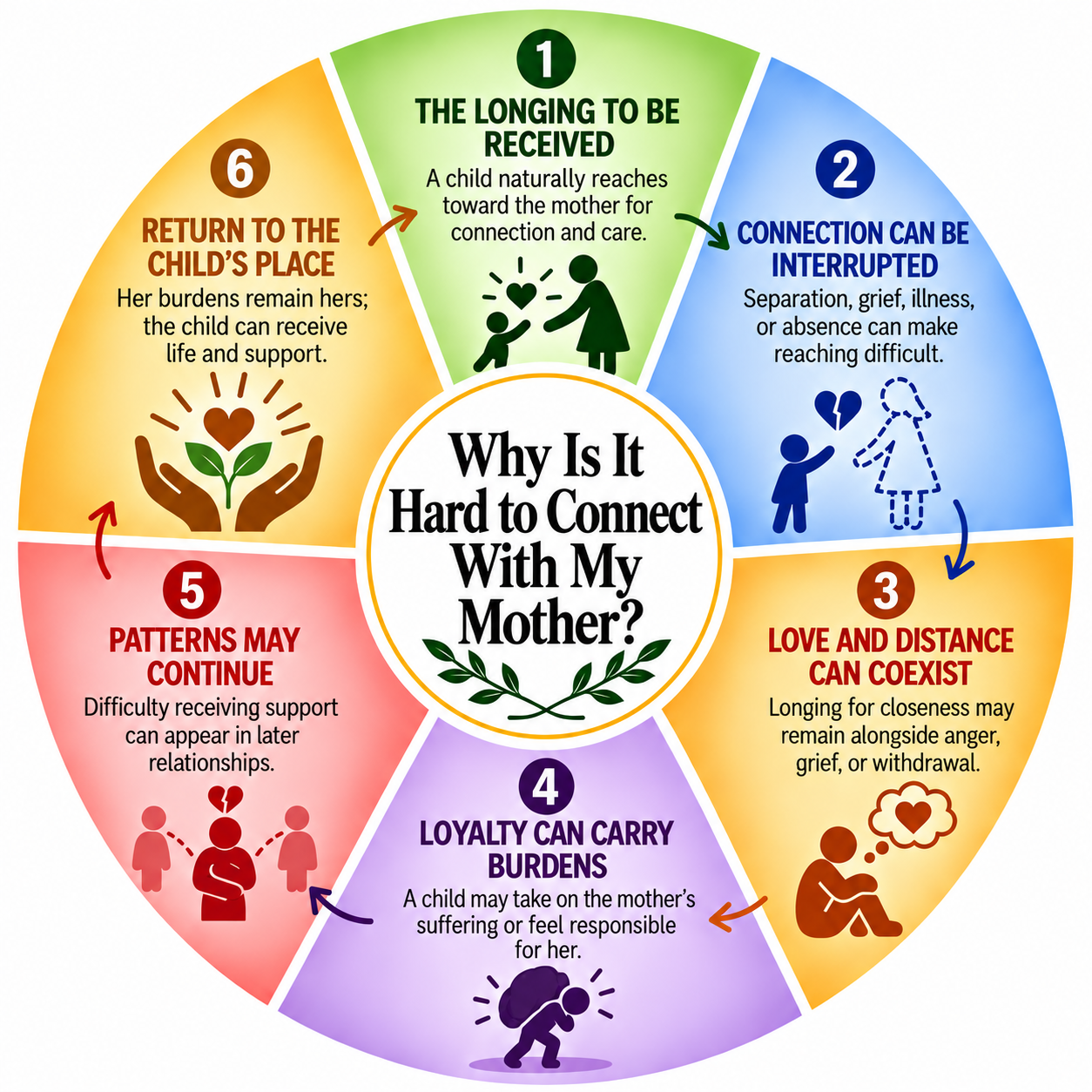
When Connection Becomes Difficult
Difficulties with the mother relationship may develop through emotional unavailability, trauma or grief, depression or overwhelm, separation during childhood, illness or hospitalization, family conflict, emotional instability, unresolved family experiences, or divided loyalties between parents.
Sometimes the disconnection is obvious. Other times, people simply grow up feeling distant without understanding why. Even loving mothers may struggle when carrying overwhelming stress, trauma, grief, or unresolved pain of their own.
Interrupted Reaching-Out
From birth, babies instinctively reach toward their mother and naturally expect to be received by her. Separation, rejection, emotional absence, fear, or overwhelming circumstances can interrupt that movement. The child may turn away because reaching has become painful while continuing to long for closeness.
Later, the person may find it difficult to receive care, trust support, or allow themselves to need someone. They may want connection while withdrawing when it becomes available. The earlier longing remains, together with the fear of again reaching toward someone who cannot receive them.
Loyalty and Entanglement
Distance from the mother does not necessarily mean that the connection has ended. Through unconscious love and loyalty, a child can remain deeply connected to her grief, loneliness, or suffering while finding it difficult to receive from her as their mother.
Divided loyalty can also stand between them. Receiving the mother may feel like betraying the father or another family member. These are different movements: reaching that was interrupted, identification with the mother’s suffering, and loyalty that makes moving toward her feel disloyal to someone else. A constellation follows the particular relationship that becomes visible.
Carrying the Mother’s Burden
A child may try to carry the mother’s grief, fear, or loneliness as though saying, “Better me than you.” They may become attentive to her needs, hide their own, or take responsibility for keeping her from suffering further. What began as a way of staying close can continue into adulthood through guilt, exhaustion, or difficulty turning toward their own life.
A constellation can bring attention to what the mother carries and how the child has become connected to it. Recognizing whose suffering it is allows the person to remain connected through love while taking their place as the child, rather than becoming responsible for the mother’s life or fate.
When the Earlier Relationship Continues in Adult Life
Love, anger, grief, and longing can remain present together. A person may want closeness with their mother while remembering what made reaching painful. They may long to be received and also protect themselves from needing her again. Acknowledging both movements does not require forcing closeness or denying what happened.
This protection can continue in the body. Reaching toward someone, asking for help, or allowing another person to come close may bring tension, vigilance, numbness, or an impulse to withdraw. Even when care is available now, the person may respond as though reaching will again meet rejection, absence, or disappointment.
Adult relationships can become the place where the earlier longing continues. A person may pursue an unavailable partner, care for others while hiding their own needs, or pull away when a relationship becomes close. The partner may become the person from whom they are still seeking something that was missing with the mother.
A constellation can bring attention to whom the person is reaching toward and what they continue to expect or fear. Recognizing the earlier relationship helps distinguish the longing for the mother from what can be given and received between adults now.
Movement Toward Healing with Family Constellations
Movement toward healing begins with seeing what stands between the child and mother. A constellation can distinguish an interrupted reaching from divided loyalty, responsibility for the mother, or identification with her suffering. Each requires attention to its own relationships.
Where reaching was interrupted, what happened and what was not received are acknowledged. Where loyalty to another person prevents receiving, that person is given a place without requiring the child to reject the mother. Where the child carries her burden, it remains with her while the child returns to their own place.
The mother remains the mother, and life came through her. Recognizing this does not deny what was missing or require renewed contact, closeness, or reconciliation. The person can remain truthful about the relationship and turn toward their own life without making closeness with the mother a condition for doing so.
About the Author
Barry Krost has been studying Family Constellations since 2003 and has over 40 years of experience in bodywork, somatic education, and systemic healing. He teaches Family Constellations internationally, mentors facilitators through his Training & Certification Program, and has presented at international systemic constellations conferences. His Resource Library reflects decades of professional experience and ongoing study, offering clear, thoughtful, and grounded education to help individuals and professionals better understand Family Constellations.
Explore Further
You may also be interested in:
Ready to explore how these dynamics may be affecting your own life?
Schedule a Complimentary Consultation to discuss whether Family Constellations may be right for you.
Frequently Asked Questions
Why do I feel emotionally distant from my mother?
This may relate to emotional protection, interrupted connection, trauma, unconscious loyalty, or unresolved family experiences.
Can childhood trauma affect the mother relationship?
Yes. Trauma, fear, emotional absence, separation, or instability may continue affecting connection throughout adulthood.
Why do I feel both love and anger toward my mother?
Conflicting emotions are common when deep longing, unresolved pain, loyalty, and emotional hurt exist simultaneously.
Can early maternal connection affect adult relationships?
Yes. Early maternal experiences may influence intimacy, emotional regulation, trust, self-worth, and the ability to give and receive in relationships.
What is interrupted reaching-out movement with the mother?
Interrupted reaching-out may occur when a child's natural movement toward the mother becomes interrupted, strained, or unsafe. The child may continue longing for connection while also adapting to what could not be reached or received.
Why do I have difficulty receiving care or support?
When reaching toward the mother has been painful, unavailable, or unpredictable, a child may adapt by resisting care. Later in life, depending on others or allowing vulnerability may continue to feel difficult.
Why do I feel responsible for my mother's emotions or happiness?
Children may become highly attuned to a mother's emotional state and unconsciously try to carry what belongs to her. This may contribute to over-responsibility, guilt, caretaking, and difficulty separating later in life.
Can unconscious loyalty affect my relationship with my mother?
Yes. A child may remain deeply connected to the mother's suffering through unconscious loyalty and become entangled with unresolved relationships, traumatic events, overwhelming grief, or experiences within the family that could not be acknowledged.
Can I have a difficult relationship with my mother even if she loved me?
Yes. Love may be present even when trauma, grief, overwhelm, emotional unavailability, or unresolved family experiences interfere with a mother's ability to be emotionally present and receive her child.
Can Family Constellations help explore mother relationship patterns?
Family Constellations provides one way of exploring unconscious loyalties, entanglements, interrupted connection, and unresolved family patterns that may be influencing the relationship with the mother.
