
Loss belongs to every family story, but not every loss is mourned, spoken about, or given a place. Family Constellations considers who was lost, how others were affected, and whether later family members became connected to unresolved grief. Personal grief and entanglement with another person’s loss are distinct experiences that can exist together.
Introduction
Loss is part of every family story.
Families experience the loss of loved ones, relationships, homes, health, dreams, identities, cultures, and ways of life. Some losses are acknowledged and mourned. Others remain hidden, unspoken, or without a place in the family story.
Grief is a natural response to loss. At times, however, a loss cannot be fully grieved or acknowledged. The person who was lost may be forgotten or excluded, while later generations may become entangled with the loss or with someone who suffered because of it.
Family Constellations offers a systemic perspective on grief and loss. Rather than viewing grief solely as an individual experience, it considers what happened in the family, who was lost, who may have been forgotten or excluded, and how the loss may continue to affect the family across generations.
Grief Is a Natural Response to Loss.
Grief is not a problem to be fixed.
It is a natural response to:
Death
Separation
Divorce
Miscarriage
Stillbirth
Illness
Migration
Loss of homeland
Loss of identity
Loss of relationships
Unfulfilled hopes and dreams
Grief reflects the significance of what has been lost.
Grieving does not mean forgetting. It allows us to acknowledge the loss, recognize what has changed, and remain connected to what or whom we have lost while continuing with our own lives.
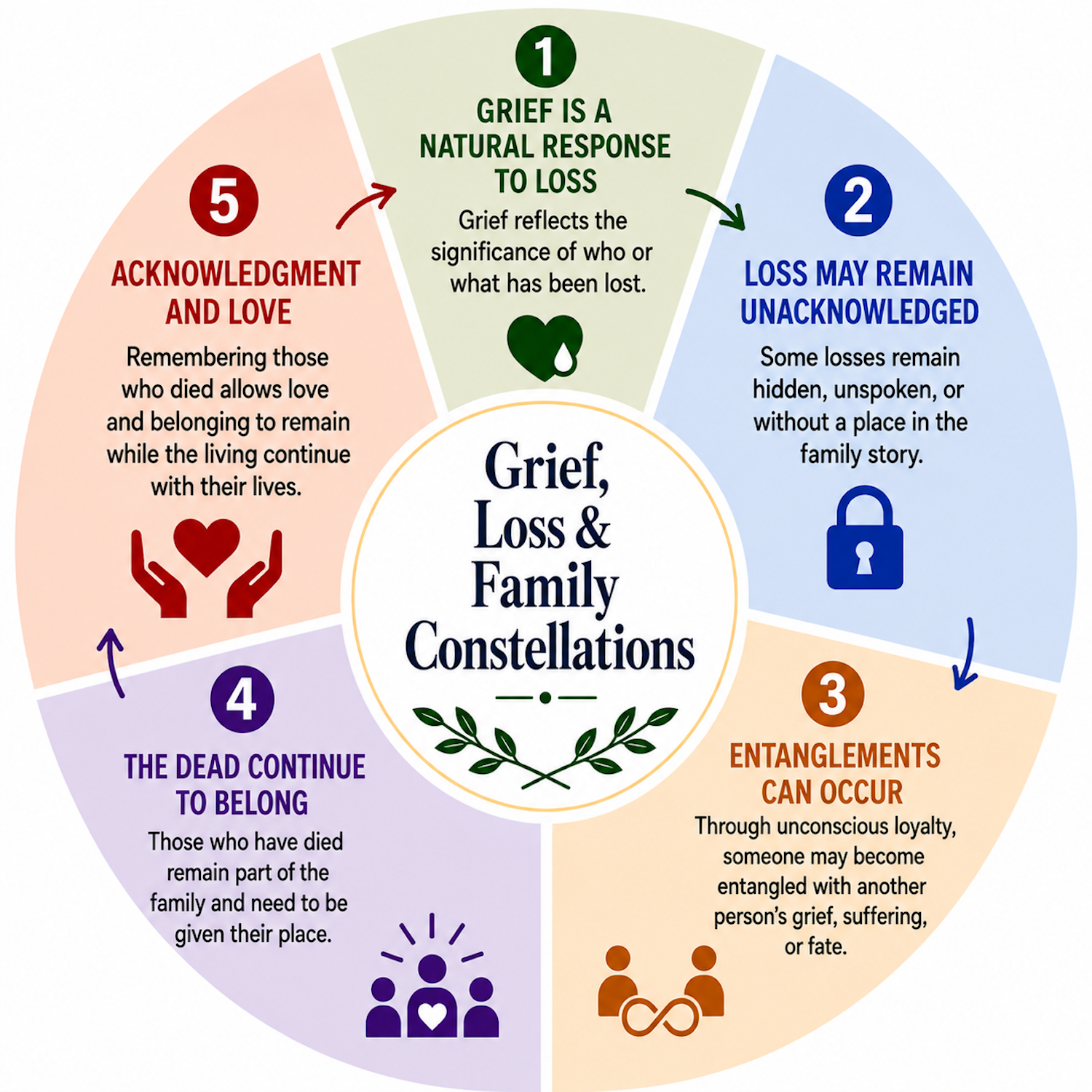
The visual map below brings together the central ideas explored in this article. It shows how grief and loss may be understood within the family system through acknowledgment, belonging, unconscious loyalty, and entanglement, while recognizing that those who have died continue to have their place within the family.
When Grief Cannot Be Fully Felt
Not all losses are fully mourned.
Sometimes circumstances leave little opportunity for grieving. A family may need to survive, continue caring for children, leave a homeland, rebuild a life, or face other losses before there has been time to acknowledge what happened.
This may occur when:
A death is sudden
A loss is traumatic
Survival becomes the priority
Several losses occur close together
The person who died cannot be openly mourned
The circumstances surrounding the loss remain hidden or unspoken
The family may continue without fully acknowledging the person who was lost or what happened. The loss can then remain present within the family even when it is rarely spoken about.
Later generations may become connected to what was not grieved, acknowledged, or given a place.
The Family System Remembers
A death can remain present within a family long after the event, including when the person who died is no longer spoken about. When the loss could not be fully faced, a living family member may remain bound to the dead through grief, guilt, or a difficulty turning toward their own life.
A later family member may become identified with the person who died or with someone whose grief remains unresolved. Through unconscious love and loyalty, they may share the suffering or feel that living fully would mean leaving someone behind. The entanglement becomes a way of remaining connected and preserving belonging.
A constellation can bring attention to who died, who could not fully face the loss, and whom the descendant has become connected to. Acknowledging these different relationships allows the dead to have their place while the living remain connected through love and turn toward their own lives.
Losses That Are Often Forgotten
Some losses are openly recognized. Others receive little acknowledgment or are rarely spoken about within the family.
These may include:
Miscarriages
Stillbirths
Children who died young
Former partners
Family members lost through war
Losses connected with immigration and displacement
Losses connected with adoption
Family members who were institutionalized
Family members who disappeared
Those who died through suicide
Individuals who were excluded or forgotten
When a loss or the person connected with it has not been acknowledged, a later family member may become entangled with what happened or with someone who was forgotten or excluded.
Acknowledgment gives the loss a place in the family story and allows those who belong to be recognized as part of the family.
Entanglement With Loss and Grief
An entanglement may connect a person with someone who died, with someone deeply affected by the death, or with a loss that could not be acknowledged. These are different relationships: identifying with a deceased sibling is not the same as sharing a parent’s grief for that sibling.
The work asks who was lost, who could not grieve, and whom the living person is connected to. Recognizing the particular relationship gives direction to the movement rather than treating all grief as the same experience.
Personal Grief and Grief Connected to the Family System
Personal grief is connected to a loss within one’s own life. The source of the grief may be clear, although its course, intensity, and duration differ for every person and every loss.
At other times, grief may also be connected to someone or something elsewhere within the family system. A person may become identified or entangled with someone who died, a parent who could not grieve, or a loss that was concealed, excluded, or never fully acknowledged.
Family Constellations does not determine that grief is inherited based upon its intensity, duration, or how it feels. It explores the known family history and the relationships that become visible within a constellation. The distinction is not between “normal” and “abnormal” grief, but between what belongs to the person’s own experience and what may connect them to another person’s loss or fate.
When an entanglement becomes visible, the earlier loss and grief can remain with those whose lives were directly affected. The person can acknowledge and honor what happened without carrying or representing it, while retaining the grief that belongs to their own life.
Belonging and the Dead
Family systems include both the living and the dead. Those who have died continue to belong. When deceased family members are remembered and given their place, they remain part of the family without someone living needing to represent them or follow their fate.
When someone who died is forgotten, denied, or excluded, a later family member may become identified or entangled with them, keeping their place present within the family system. The dead can be honored as belonging to the family while the living remain with their own lives.
Sudden and Traumatic Loss
Death through accident, violence, war, suicide, homicide, or unexpected illness can leave a family in profound shock, with little opportunity to prepare. Facing what happened and grieving the person who died may become especially difficult when the circumstances involve shame, danger, secrecy, or consequences for other family members.
The death may be concealed, minimized, or left unspoken. Yet the circumstances do not remove the person’s belonging. When the person and their death cannot be fully acknowledged, a later family member may become identified with them or remain connected to the loss through unconscious loyalty and entanglement.
A constellation turns toward both the person who died and the circumstances of the death. Acknowledging what happened and giving the person their place allows the loss to be recognized without requiring a descendant to continue carrying or repeating their suffering or fate.
Acknowledgment and the Reality of Loss
One of the most difficult aspects of grief is acknowledging what cannot be changed while continuing to give the person who died their place within the family. At times, the grief and circumstances surrounding a death can become so significant that the person themselves becomes obscured by what happened.
Acknowledgment requires facing reality as it is, recognizing what happened without denying, minimizing, judging, pitying, or rewriting it.
With loss, this means recognizing who was lost, what happened, and what cannot be changed. When someone has died, it means facing the reality of their death and recognizing their continuing place within the family, however painful that is.
Grief and Love
Grief exists because love exists, and the depth of grief often reflects the depth of connection. The goal is not to erase memories, remove love, or disconnect from those who have died.
Instead, grief often invites a different movement: from holding on through suffering to remaining connected through love. Many people discover that relationships with deceased loved ones continue through memory, gratitude, acknowledgment, and belonging.
Movement Toward Healing with Family Constellations
Movement toward healing begins with acknowledging the loss, the person who was lost, and what cannot be changed. A constellation can make visible whether someone living has become identified or entangled with the person who died, with another family member’s grief, or with a loss that was never fully acknowledged.
When those who died and those affected by the loss are given their places, a living family member no longer has to represent them, follow their fate, or remain connected through suffering. Personal grief can be distinguished from grief or fate belonging to another person or generation.
The movement is not toward forgetting the dead or ending the connection with them. They continue to belong. It is toward remembering and honoring them while allowing the dead to remain among the dead and the living to turn toward their own lives.
About the Author
Barry Krost has been studying Family Constellations since 2003 and has over 40 years of experience in bodywork, somatic education, and systemic healing. He teaches Family Constellations internationally, mentors facilitators through his Training & Certification Program, and has presented at international systemic constellations conferences. His Resource Library reflects decades of professional experience and ongoing study, offering clear, thoughtful, and grounded education to help individuals and professionals better understand Family Constellations.
Explore Further
You may also be interested in:
Frequently Asked Questions
Can Family Constellations help with grief?
Family Constellations does not replace grief counseling or therapy. It provides one way of exploring how loss, belonging, exclusion, and entanglements with those who died may affect a person and their family.
Can grief affect later generations?
Losses that have not been acknowledged may continue to have a place within the family system. Later family members may become entangled with someone who died, with someone deeply affected by the loss, or with the circumstances surrounding what happened.
Why look at deceased family members?
A central principle of Family Constellations is that everyone belongs. Those who have died continue to have a place within the family. Remembering and acknowledging them can make visible where someone living has become identified or entangled with their suffering or fate.
What if I feel grief that does not seem connected to my own life?
Family Constellations considers whether there may be a significant loss elsewhere in the family system or an entanglement with someone who experienced grief, loss, or a difficult fate. This is one possible systemic perspective rather than an assumption about where the grief comes from.
What does it mean to let go of someone who died?
Letting go does not remove the person who died from the family. They continue to belong. In Family Constellations, letting go can mean allowing the person who died to have their place among the dead without someone living needing to follow them, identify with them, or share their fate.
