
Why Do I Feel Like the Outsider in My Family?
Belonging, Exclusion, and Family System Dynamics
Introduction
Many people grow up feeling different from the rest of their family. They may love their family deeply and still experience a persistent sense of being disconnected, misunderstood, unseen, excluded, or not fully received. Even when they are included, they may carry the feeling that they never quite fit in, fully belong, or have a secure place within the family.
Sometimes there is no obvious reason. Even people from loving families may carry a persistent feeling of being on the outside looking in. Others experience more direct forms of exclusion through criticism, rejection, favoritism, family conflict, or being treated differently from siblings.
Over time, many begin asking themselves:
Why do I feel different?
Why don't I belong?
Why am I always on the outside?
What is wrong with me?
What often makes this experience so painful is the deep human need to belong.
Family Constellations offers another perspective on why some people feel like outsiders within their own family and explores how this experience may be connected to belonging, exclusion, and their place within the family system.
The visual map below offers a simple overview of how the outsider place may develop within a family system and continue beyond the family. It also shows the movement toward recognizing earlier exclusions, one's own belonging, and one's own place.
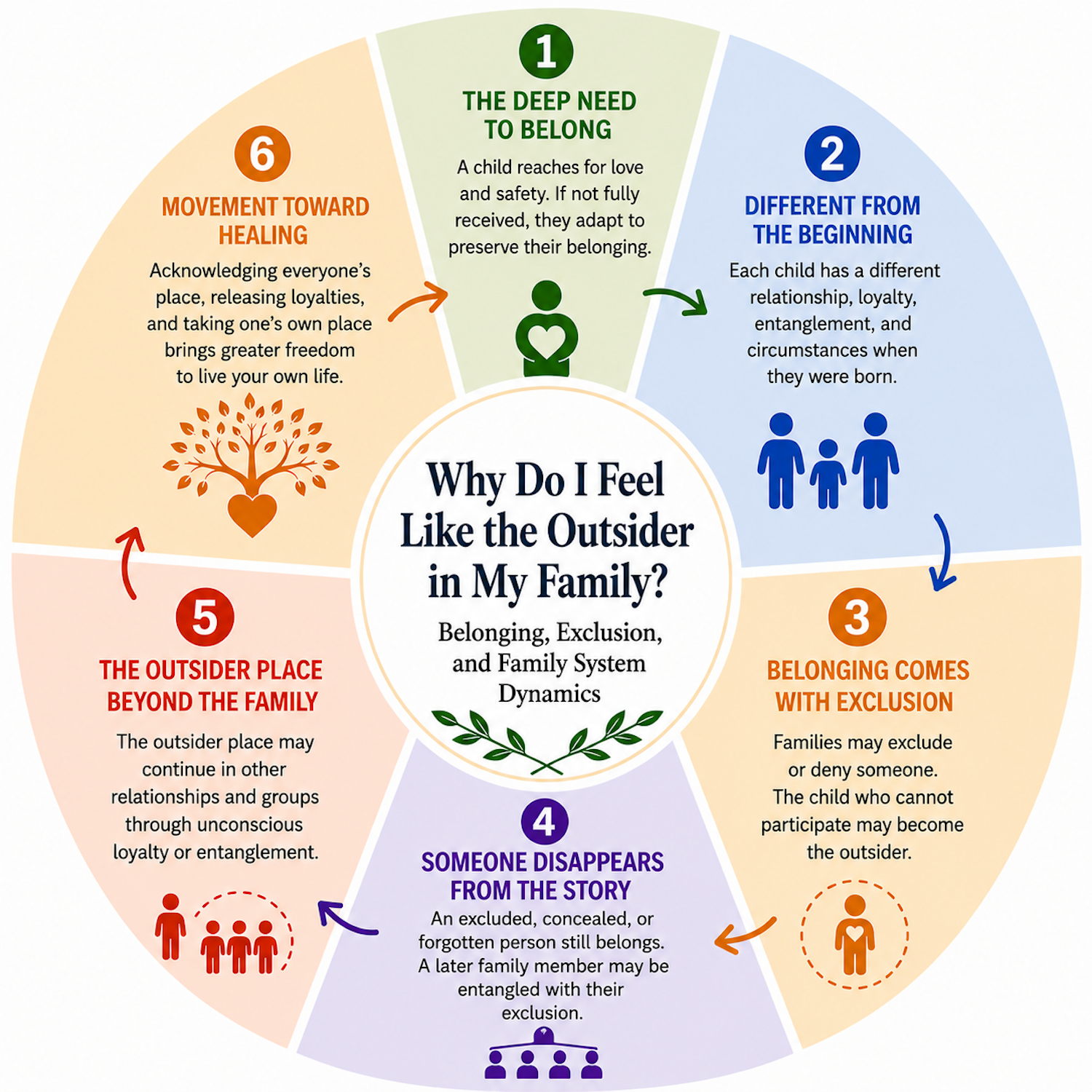
The Deep Need to Belong
One of the most important principles in Family Constellations is that everyone belongs. Belonging is not simply a preference but a fundamental human need. For a child, belonging begins with reaching toward their parents and being received. Children depend upon their families for connection, care, and survival, and their need to belong is profound.
When a child is not fully received, or when their place within the family becomes uncertain, they may feel they need to adapt in order to preserve their belonging. They may become loyal to a parent, an excluded family member, a loss, or something that happened within the family before they were born.
The feeling of being an outsider can sometimes begin here. A person may appear to have a place within the family and still experience themselves as standing outside it. The question may remain into adulthood: "Why do I feel different from everyone else?"
Feeling Different From the Beginning
Some people describe feeling different from their family from an early age. They may have experienced themselves as standing apart from their parents or siblings without understanding why.
Children within the same family can have very different relationships with their parents and different places within the family. One child may be more loyal to one parent, become entangled with someone who has been excluded, or carry a connection to a loss or event in the family that the other children do not carry.
The circumstances within the family may also have been different when each child was born. A death, separation, conflict between the parents, financial loss, illness, or another significant event may have changed the family by the time a younger child arrived.
A child can therefore belong to the same family as their siblings and still experience their place very differently. They may have felt like the outsider from the beginning without knowing what made their place different.
When Belonging Comes With Exclusion
Everyone who belongs to a family has a place within it. At the same time, families may exclude people whose lives or actions are difficult to accept. Family members may also deny losses, relationships, events, or other realities that are painful or shameful to acknowledge.
A child may experience that belonging requires accepting these exclusions. They may also feel a greater systemic need for everyone who belongs to be included and for what happened within the family to be acknowledged.
The child who cannot participate in the family's exclusion may then become an outsider themselves. They may stand with someone who was rejected, forgotten, blamed, or denied a place, even when they know little or nothing about that person's history.
In this way, being the outsider may not only be about standing apart from the family. It can also express an unconscious loyalty or entanglement with someone who stood outside the family before them.
When Someone Disappears From the Family Story
Someone who belongs to the family may be forgotten, rejected, concealed, or deliberately left out of the family's history. Over several generations, their name and what happened to them may disappear from the family story entirely.
Their absence from the family story does not change their belonging. From a systemic perspective, those who belong continue to have a place whether later generations know about them or not.
A later family member may become entangled with someone who was excluded in this way. They may experience themselves as outside the family or without a place, while knowing nothing about the earlier exclusion.
The outsider's experience may then bring an earlier exclusion back into the family in another form.
The Outsider Place Beyond the Family
When being outside becomes a person's place within the family, they may continue to experience themselves in that position elsewhere. They may find themselves outside groups, communities, friendships, or other relationships even when others are willing to include them.
Through unconscious loyalty or entanglement, belonging somewhere else can feel like leaving behind the person or people with whom they have been connected.
The movement is therefore not simply from exclusion toward inclusion. It may also involve recognizing where the outsider position began, who or what it belongs to, and that the person has their own place within their family.
Movement Toward Healing with Family Constellations
Healing often begins with:
recognizing experiences of exclusion
understanding unconscious loyalties
acknowledging people and events that have not been given their place
recognizing entanglements with those who were excluded
recognizing one's own belonging
taking one's own place within the family system
Through Family Constellations in groups, individual sessions, or workshops, people can explore where the outsider place began, whether it is connected to an earlier exclusion, and what becomes possible when those who belong are acknowledged and given their place.
Through this process, participants may experience:
less need to remain outside
greater freedom from earlier entanglements
a clearer sense of their own place
greater capacity to receive belonging
greater connection with their family and others
more freedom to live their own life
A Grounded Perspective
Feeling like an outsider can have many influences. Personality, temperament, life experiences, culture, and other circumstances may all contribute to how someone experiences belonging within their family and elsewhere.
Family Constellations offers one way of understanding how belonging, exclusion, unconscious loyalty, and entanglement may be connected to the outsider place within a family.
This perspective does not replace therapy, psychological care, or medical treatment. It offers a systemic perspective that can be considered alongside other ways of understanding this experience.
About the Author
Barry Krost has been studying Family Constellations since 2003 and has over 40 years of experience in bodywork, somatic education, and systemic healing. He teaches Family Constellations internationally, mentors facilitators through his Training & Certification Program, and has presented at international systemic constellations conferences. His Resource Library reflects decades of professional experience and ongoing study, offering clear, thoughtful, and grounded education to help individuals and professionals better understand Family Constellations.
Explore Further
You may also be interested in:
Ready to explore how these dynamics may be affecting your own life?
Schedule a Complementary Consultation to discuss whether Family Constellations may be right for you.
Frequently Asked Questions
Why do I feel like the outsider in my family?
From a systemic perspective, feeling like the outsider may be connected to one's place within the family, experiences of exclusion, unconscious loyalty, or an entanglement with someone who was previously excluded or not given their place.
Is feeling like the outsider the same as being a scapegoat?
Not always. A scapegoat is often given a particular place within the family by carrying blame or becoming the one who is rejected. An outsider may experience themselves as standing apart from the family without carrying the scapegoat role.
Can family secrets contribute to feeling like an outsider?
They can. Someone who belongs to the family may have been concealed, forgotten, rejected, or removed from the family story. A later family member may become entangled with that person and experience something of their exclusion without knowing where it began.
Why do I feel like I don't fit in even though my family loves me?
Love and belonging are not necessarily the same as experiencing one's own place clearly. A person can be loved by their family and still experience themselves as standing outside it, particularly when they are connected through unconscious loyalty or entanglement to an earlier exclusion.
Can Family Constellations help with feelings of exclusion?
Family Constellations provides one way of exploring where the outsider place may have begun, whether it is connected to an earlier exclusion or entanglement, and what becomes possible when those who belong are acknowledged and given their place.
