
Why Do I Feel Like I Don’t Belong?
A person can belong to a family while feeling different, unseen, or unable to find their place. Interrupted connection and unconscious loyalty to someone excluded may contribute to this experience. Family Constellations distinguishes fitting in from systemic belonging and considers how earlier family relationships continue within the search for acceptance and connection now.
Introduction
Many people carry a painful feeling of not fully belonging. They may feel different from their family, disconnected from others, unseen within relationships, or alone even when surrounded by people who care about them. Some experience this only in certain situations. For others, it remains quietly present wherever they go.
They may wonder:
“Why don’t I fit in?”
“Why do I always feel different?”
“Why does everyone else seem to belong except me?”
“Is there something wrong with me?”
Few experiences are more painful than feeling as though you do not have a place.
Family Constellations offers one way of understanding how belonging, exclusion, interrupted connection, unconscious loyalty, and family history may become connected to this experience. It begins with an important systemic distinction: fitting in and belonging are not the same.
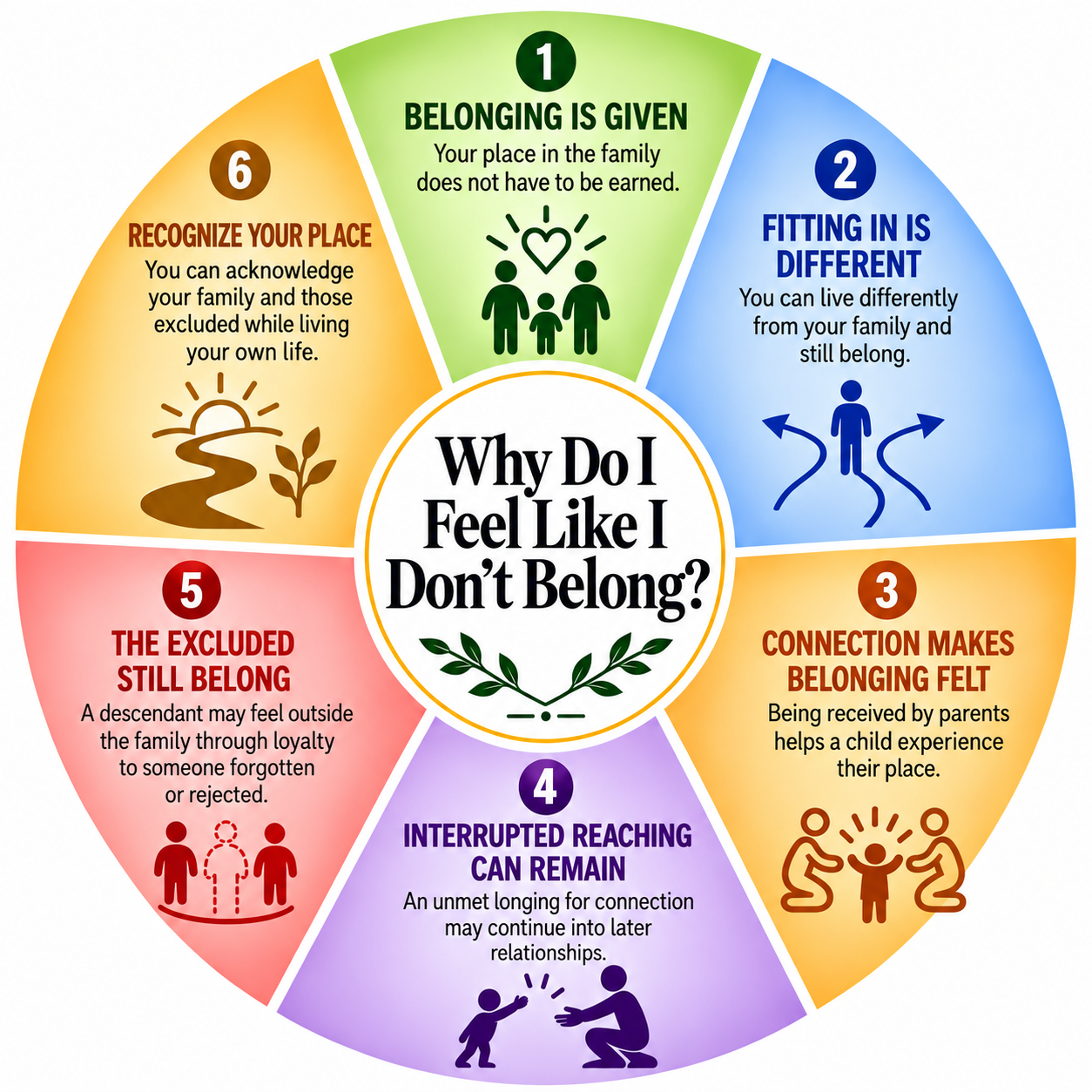
The Difference Between Fitting In and Belonging
Fitting in often involves being similar to others, meeting expectations, or being accepted by the people around us. A person may try to fit in by hiding important parts of themselves, adapting to what others want, or living according to the expectations of their family or community.
Belonging within the family system is different. A child belongs to their family by birth. Their place does not depend upon being similar to other family members, meeting family expectations, or earning acceptance.
When belonging has come to feel dependent upon fitting in, being fully oneself may seem to threaten one’s place in the family. A person may then feel caught between remaining connected to the family and living differently from it.
From a systemic perspective, being different does not take away a person’s place. They can make different choices, follow their own path, and live their own life while continuing to belong to the family from which they came.
Belonging Begins in the Family
Every child belongs to their family. The experience of belonging, however, develops through connection. Children instinctively reach toward their parents to be received, held close, protected, and cared for. Through this reaching and receiving, the child experiences their place not only as a systemic reality but as something they can feel.
When the child’s reaching is received, connection can support a lived sense of belonging. When it is interrupted or cannot be fully received, the child still belongs, but they may not experience their place so clearly. The longing to be received can then remain connected to how they experience themselves, their family, and their relationships with others.
When Connection Is Interrupted
A child’s reaching toward their parents may be interrupted by separation, illness, hospitalization, adoption, loss, emotional absence, prolonged distance, or difficulties within the parents’ relationship. A parent may remain physically present while being unable to fully receive the child because of grief, trauma, illness, family burdens, or their own interrupted connection.
When reaching has been painful or repeatedly unmet, the child may eventually stop reaching. The movement toward the parent does not necessarily disappear. It may remain as unresolved longing, loneliness, anger, withdrawal, or difficulty receiving closeness and support.
Later in life, a person may deeply want connection while also finding it difficult to reach toward others or trust that they will be received. This does not mean that they do not belong. It reflects the difference between having a place within the family and being able to experience that belonging through connection.
Feeling Different Within the Family
Many people who struggle with belonging remember feeling different from their family long before they understood why. They may have felt separate from their siblings, misunderstood by their parents, or unlike everyone around them.
Children within the same family may have different experiences and carry different loyalties and entanglements. One child may experience an interruption in connection that their siblings did not experience, such as the death of a parent, difficulties within the parents’ relationship, separation, or divorce. Another may become connected to someone from an earlier generation who was excluded, forgotten, or experienced themselves as outside the family.
Even children who grow up in the same family do not necessarily experience the same family relationships or carry the same systemic connections. One child may therefore experience themselves as different from their siblings or as though they do not quite fit within the family.
Feeling different does not take away a person’s place. They continue to belong even when their experiences, choices, or way of living differ from those of other family members.
Exclusion and Unconscious Loyalty
One of the central observations of Family Constellations is that everyone who belongs to a family system has a place within it. When someone is excluded, forgotten, rejected, or denied their place, that exclusion may remain active within the family and become connected to later generations through unconscious loyalty and entanglement.
Later family members may become unconsciously identified with someone who was excluded. Without knowing the connection, they may experience themselves as outside the family or find themselves occupying a similar place—again becoming the one who is different, rejected, or does not seem to belong.
The feeling of not belonging can involve more than a person’s immediate relationships. It may also express an unconscious loyalty to someone whose place within the family has not been fully recognized.
Family Secrets and Hidden Histories
Exclusion does not always happen through open rejection. Sometimes a person or event gradually disappears from the family story through silence, concealment, or the passing of generations. A family history may include previous relationships, children who died young, adoption, abandonment, violence, imprisonment, concealed parentage, or family members whose existence or experiences were never acknowledged.
What is no longer spoken about does not cease to belong to the family. Silence may remove a person or event from the known family story, but it does not remove their place within the family system.
A later family member may experience something of that exclusion without knowing the person or the history to which they are connected. They may then experience themselves as outside the family or as though their own place is uncertain.
Recognizing the family history does not determine a single explanation for the experience of not belonging. It opens the possibility that the feeling may be connected not only to the person’s present circumstances but also to someone who has been missing from the family’s awareness.
Searching for Belonging Somewhere Else
People who do not experience a clear place within their family may spend years searching for somewhere they finally belong. They may look for belonging through relationships, friendships, careers, achievement, spiritual communities, helping others, or becoming the person others need them to be.
These relationships and communities can provide meaningful experiences of connection and belonging. Yet when the feeling of being outside is connected to interrupted connection, exclusion, or an unconscious loyalty within the family, being welcomed elsewhere may not fully change it.
A person may be accepted and valued in many places while continuing to feel that they do not belong. They may repeatedly adapt themselves to fit the expectations of others or fear that showing who they are will place connection at risk.
From a systemic perspective, the movement is not only toward finding another place to belong. It also involves recognizing the place the person already has within their family while allowing support and connection from others to be received.
Finding Your Place
One of the deepest movements occurs when a person stops asking:
“How do I fit in?”
and begins asking:
“What is my place?”
These questions reflect a different movement. Rather than looking to others to confirm their place, a person begins to recognize the place that is already theirs.
A person can acknowledge the family from which they came without repeating its patterns or carrying what belongs to others. They can remain connected while making different choices, living differently, and turning toward their own life.
The movement is not toward earning a place within the family or becoming someone the family can accept. It is toward recognizing the place that is already theirs and allowing others—including those who were forgotten, rejected, or excluded—to have their places as well.
About the Author
Barry Krost has been studying Family Constellations since 2003 and has over 40 years of experience in bodywork, somatic education, and systemic healing. He teaches Family Constellations internationally, mentors facilitators through his Training & Certification Program, and has presented at international systemic constellations conferences. His Resource Library reflects decades of professional experience and ongoing study, offering clear, thoughtful, and grounded education to help individuals and professionals better understand Family Constellations.
Learn more about Barry Krost
Explore Further
You may also be interested in:
Ready to explore how these dynamics may be affecting your own life?
Schedule a Complimentary Consultation to discuss whether Family Constellations may be right for you.
Frequently Asked Questions
Why do I feel like I don’t belong?
The feeling may be connected to experiences within your own life or to interrupted connection, exclusion, unconscious loyalty, entanglement, or unresolved events within the family. Family Constellations offers one way of considering whether the experience may also be connected to someone who was forgotten, rejected, or denied their place.
Why do I feel like I don’t fit in anywhere?
Fitting in and belonging are not the same. A person may be accepted in many places while continuing to experience themselves as outside. When this feeling is connected to interrupted connection or a systemic loyalty, finding another place to fit in may not fully change it.
What is the difference between fitting in and belonging?
Fitting in may involve being similar to others, meeting expectations, or receiving their acceptance. Belonging within the family system does not have to be earned. A person belongs to their family by birth, even when they live differently from other family members.
Can family exclusion affect later generations?
From a Family Constellations perspective, a later family member may become unconsciously identified with someone who was rejected, forgotten, concealed, or excluded. They may then experience a similar sense of being outside or not having a place.
Why do I feel different from my family?
Children within the same family may experience different relationships, losses, interruptions, and systemic connections. Feeling different does not remove a person’s place within the family. They can belong while making different choices and living their own life.
Why do I feel alone even when other people accept me?
Being accepted by others and experiencing belonging are not necessarily the same. A person may be welcomed and valued while still carrying the effects of interrupted connection or an unconscious identification with someone who was excluded.
Can Family Constellations explore difficulties with belonging?
Family Constellations provides one way of exploring whether difficulties with belonging are connected to interrupted connection, unconscious loyalties, entanglements, exclusions, or people and events within the family history.
