
A Visual Learning Map on Sibling Conflict in Family Systems
Sibling conflict is often understood in terms of personality differences, communication styles, or life circumstances.
In Family Constellations, we often see something more complex at work. The relationship between siblings can be shaped by deeper dynamics within the family system—particularly belonging, loyalty, and what has not yet been resolved in previous generations.
At times, conflict between siblings is not only about the present. It may also reflect unresolved experiences within the family that are seeking acknowledgment.
The map below offers a way of understanding how these patterns can form and how they may begin to shift. You might also read more about sibling dynamics or join our next workshop on sibling conflicts
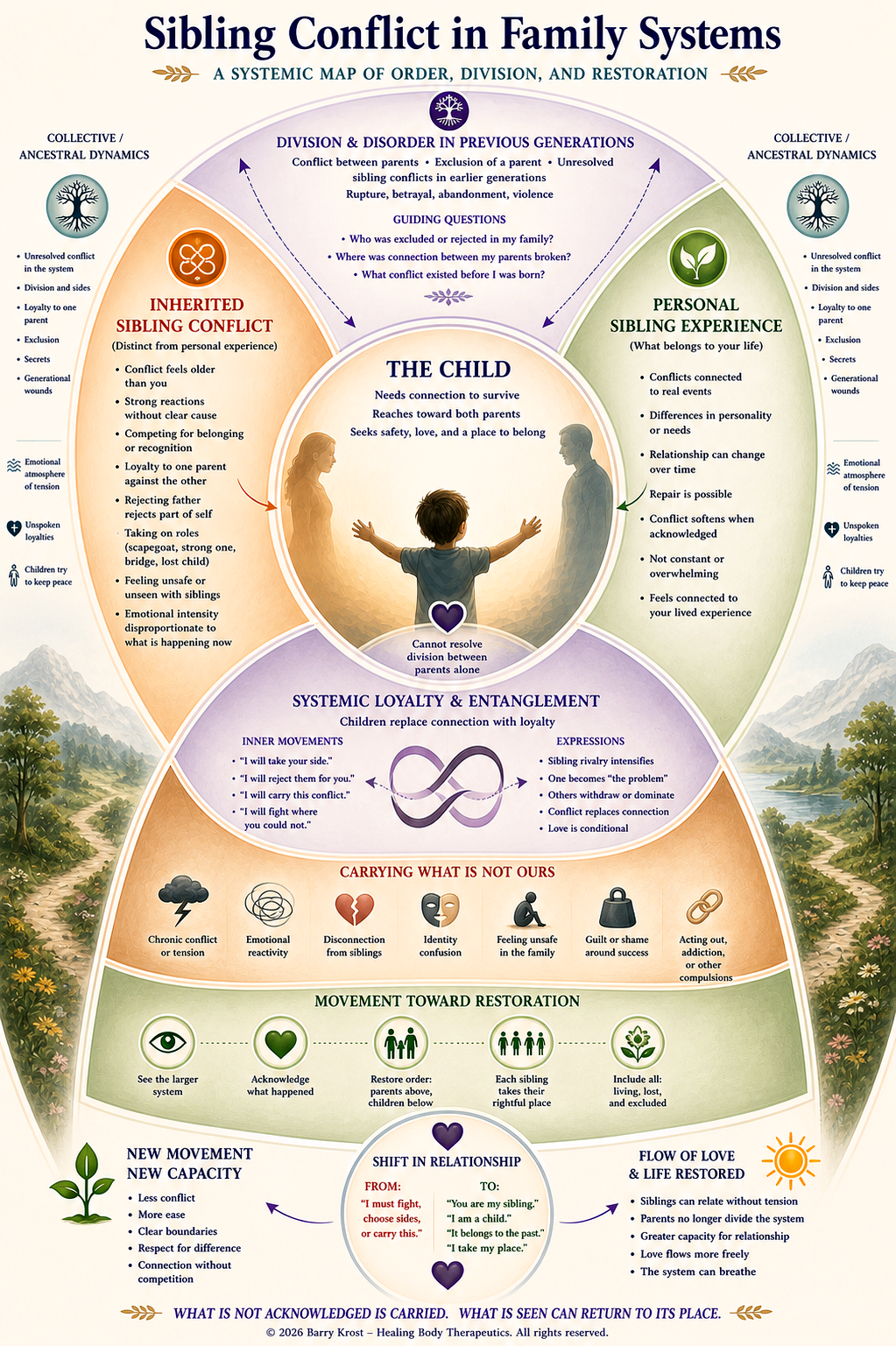
The visual map above offers a way of understanding how these patterns can form and how they may begin to shift. Sibling relationships can be complex and meaningful. When underlying dynamics are brought into awareness, it may become possible to relate with greater clarity, less tension, and a stronger sense of place within the family.
Understanding the Pattern
When there is tension or division between parents, children are often affected in ways that are not immediately visible.
A child may feel pulled toward one parent, or may reject the other in order to belong. These movements are usually not conscious—they arise from a deep need for connection and safety.
Within this dynamic, siblings may begin to relate to one another through competition, distance, or conflict.
Inherited vs Personal Conflict
Not all sibling conflict has the same origin.
Some experiences feel connected to real events and can shift when they are acknowledged.
Other forms of conflict may feel older, more intense, or difficult to explain. These may be connected to inherited dynamics within the family system.
Recognizing this distinction can open a different way of relating to what is happening.
Systemic Loyalty
Children often respond to what is unresolved in a family through loyalty.
This may appear as:
taking sides
carrying emotional burdens
expressing what could not be spoken
In this way, conflict between siblings can become a continuation of something that came before.
Movement Toward Resolution
When the larger system is seen and acknowledged, something can begin to change.
This may include:
restoring order between parents and children
allowing each sibling to take their place
including what has been excluded
releasing what does not belong
These movements do not erase the past, but they can change how it is carried.
Closing
Sibling relationships can be complex and meaningful. When underlying dynamics are brought into awareness, it may become possible to relate with greater clarity, less tension, and a stronger sense of place within the family.
Further Explore Sibling Conflicts
Schedule a Online Family Constellations Private Session
Sibling Conflicts as Systemic Entanglement
Saturday, May 30, 2026 from 10:00am – 1:30pm CDT.
